
Interior Wall & Ceiling Leak Detection in Medford, OR
A brown ceiling ring or blistering paint along a hallway wall only shows where escaping water finally soaked through gypsum board—not where the pipe or drain actually failed. Medford Leak Detectives uses thermal imaging, capacitance moisture meters, acoustic riser probes, and fixture isolation testing to trace wall and ceiling leaks to their exact origin before any drywall is opened.
Why Wall and Ceiling Water Stains Appear Far From the Actual Leak
When water escapes inside an enclosed wall cavity or second-story floor joist bay, building materials redirect its path long before you see a single drop. In a two-story Medford home or attic-routed ranch house, water leaking from a shower mixing valve, PEX manifold tee, or upstairs toilet wax ring flows horizontally along wood top plates, floor trusses, I-joists, or drywall tape seams until it hits a drywall screw, recessed light can, or low dip in the ceiling sheetrock.
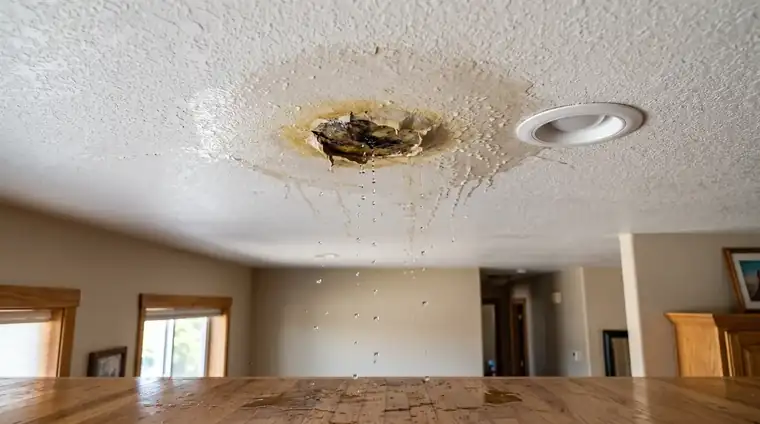
Cutting a hole directly through the visible ceiling stain frequently exposes wet insulation and a damp joist while the actual leaking fitting sits 4 to 10 feet away behind an upstairs vanity or shower wall. Medford Leak Detectives maps the entire moisture gradient and tests the pressurized supply lines, drain traps, and fixture enclosures systematically so access is opened only at the true source.
Four Distinct Sources of Wall & Ceiling Moisture in Medford Homes
Not every ceiling drip or wet wall is caused by a pressurized water pipe. Our diagnostic protocol separates four completely different moisture sources during the visit:
| Moisture Source Category | Timing & Meter Behavior | Typical Medford Examples | How We Confirm It |
|---|---|---|---|
| 1. Pressurized Domestic Supply Line Leak | Continuous 24/7 wetting; MWC street meter low-flow indicator moves with all fixtures off | Pinhole in copper shower riser, weeping PEX manifold crimp in attic/wall, or leaking ice-maker supply line | Static pressure gauge test + contact acoustic probe on angle stops/risers + thermal plume scan |
| 2. Sanitary Drain, Waste or Trap Leak | Stain grows ONLY when a specific upstairs sink, tub, toilet, or washing machine is used; meter does NOT move | Cracked ABS/PVC tub waste-and-overflow shoe, failed toilet wax ring, or loose slip-joint P-trap behind a wall | Sequential fixture dye/flood testing + inspection borescope + thermal tracing with warm water flow |
| 3. Shower Pan, Tile Grout or Escutcheon Seepage | Appears 15–30 minutes after someone takes a shower (but NOT when filling the tub with the spout alone) | Failed fiberglass shower corner caulk, cracked tile mortar bed, or unsealed shower arm escutcheon plate | Plugged shower pan flood test (below curb) vs. isolated shower riser pressure test + spray-zone testing |
| 4. Roof Flashing, HVAC Condensate or Vent Condensation | Triggered by Rogue Valley rainstorms, heavy winter attic frost thaw, or summer AC operation | Blocked AC evaporator condensate pan in attic, leaking plumbing vent boot flashing, or uninsulated bath fan duct | Attic visual/thermal inspection + moisture readings along roof rafters and vent penetrations |
Plaster & Lath vs. Modern Drywall in Medford Neighborhoods
- Historic Lath-and-Plaster Walls (McLoughlin, Downtown & Liberty Park): Homes built between 1900 and 1945 feature thick lime plaster keyed into horizontal wood lath strips, often reinforced with wire mesh at corners. Plaster absorbs far more water than modern gypsum drywall before staining, and cutting into historic plaster destroys original textures. We use contact acoustic probes on exposed fixture valves, deep-sensing moisture meters, and 6mm micro-borescopes through existing escutcheon holes whenever possible to avoid cutting historic plaster.
- Two-Story & Split-Level Frame Homes (East Medford, North Medford & Southeast Medford): Homes along Foothill Road, Lone Pine, and Cedar Links often route PEX or copper manifolds through second-floor bonus room kneewalls and truss bays. High static water pressure in East Medford can cause tub/shower diverter cartridges and vertical copper risers to develop pinholes inside insulated exterior walls.
- Attic HVAC & Recirculation Lines: Many custom Rogue Valley homes have attic-mounted air handlers or hot-water recirculation loops. When a secondary condensate drain switch fails in July or a recirculation check valve weeps, ceiling stains appear over hallways and bedrooms.
Our 5-Step Wall & Ceiling Leak Diagnostic Procedure
- Supply Line Pressure Check: We check the water meter and household static PSI first. If pressurized water is escaping continuously, we isolate hot and cold supply zones to identify the active pipe circuit.
- FLIR Infrared Thermal Mapping: Evaporating moisture inside a wall or ceiling cavity cools the surface of gypsum drywall by 2°F to 6°F (or warms it if a hot water pipe is leaking). Our high-resolution infrared camera outlines the hidden moisture footprint behind paint, wallpaper, or textured ceilings.
- Pin & Pinless Moisture Gradient Tracing: Because thermal cameras show temperature differences rather than water directly, we confirm every thermal anomaly with calibrated pin and pinless moisture meters—tracing from the lowest edge of the stain uphill to the highest saturation point where water enters the framing bay.
- Controlled Fixture & Enclosure Isolation Testing: When the supply lines hold tight pressure, we test upstairs fixtures one component at a time: plugging and filling the shower pan first, then testing the drain trap with warm dyed water, then testing the shower riser and valve body under dynamic flow.
- Micro-Borescope Visual Confirmation & Repair: When needed, we slide a flexible fiber-optic inspection camera behind a shower trim plate or through a tiny 1/4-inch pinhole concealed behind a baseboard to visually confirm the dripping joint before making a clean, square repair cut.
Safety Precautions When You Notice a Wet Ceiling or Wall
Wet gypsum drywall loses up to 75% of its structural shear strength and can pull right over the heads of drywall screws if water pools on top of a vapor barrier or heavy blown-in attic insulation. If a ceiling is sagging, bubbling, or dripping through a light fixture, smoke detector, or bath fan: turn off the circuit breaker for that room at your main electrical panel immediately, move furniture or people out from underneath, and stop using any upstairs bathroom above the stain until we inspect it.
Practical Cost Considerations & Targeted Pipe Repair
Interior wall and ceiling leak detection in Medford typically is provided with clear upfront estimates depending on whether the source is a straightforward supply riser/valve leak or requires multi-stage upstairs bathroom flood and drain isolation testing.
Once we confirm that the leak is a plumbing pipe, valve, or drain fitting (rather than a roof shingle issue), our plumbing technicians can make a neat, stud-to-stud access cut (often through the back of an adjacent closet or vanity cabinet so your bathroom tile stays untouched!), repair the copper, PEX, or ABS drain line, and verify zero drips before you patch the drywall.
Pinpoint Wall & Ceiling Leak Locating + Complete Plumbing Repair
Medford Leak Detectives locates concealed wall and ceiling leaks and completes the plumbing repair across Medford and Jackson County:
- Rear-Access Shower Valve & Riser Repairs: Accessing leaking tub/shower valves through closet or hallway drywall backing so bathroom tile never has to be broken.
- Upstairs Drain, Waste & Overflow Replacement: Fixing cracked ABS/PVC traps, tub waste shoes, and leaking toilet flanges.
- Supply Line & Manifold Splices: Repairing pinhole copper risers, PEX manifold joints, and washing machine outlet boxes.
Call (541) 906-0245 to schedule wall and ceiling leak detection in Medford, OR.
Wall & Ceiling Leak Detection in Medford, OR: Frequently Asked Questions
Answers to common questions about ceiling stains, upstairs showers, lath-and-plaster walls, and how to avoid unnecessary drywall damage.
How do I know if a ceiling water stain is from a plumbing pipe or a roof leak?
Check two things: timing and your water meter. If the stain darkens or drips during dry weather after someone uses an upstairs shower, flushes a toilet, or runs laundry—or if your Medford Water Commission meter moves with all taps off—it is a plumbing leak. If the stain is on the top floor beneath an attic with no water pipes overhead and only grows during Rogue Valley rainstorms, roof flashing is the prime suspect.
Why does my downstairs ceiling only drip when someone takes a shower upstairs, but not when we fill the bathtub?
That classic clue eliminates the pressurized water supply pipes (which are under pressure 24/7) and usually points to one of three things: water spraying past an uncaulked shower valve trim plate/tub spout, water seeping through cracked tile grout or shower door tracks when someone stands in the shower, or a leak in the upper shower arm threaded inside the wall.
Can you access a leaking shower valve without tearing out my bathroom tile?
In most Medford homes, the wall behind the shower valve backs up to a bedroom closet, hallway wall, or vanity cabinet. Once we confirm the leak at the shower valve or riser, we cut a clean rectangular access panel through the drywall on the back side of the wall, complete the plumbing repair, and leave your tiled shower wall completely intact.
Does thermal imaging see the actual pipe through drywall?
Infrared thermal cameras do not see through solid gypsum board like an X-ray. Instead, they detect minute surface temperature differences (as small as 0.1°C) caused by evaporative cooling where wet drywall and framing are colder than dry drywall, or conductive heat from a hot water line. We always confirm thermal patterns with a pin/pinless moisture meter and acoustic probe.
Why is paint bubbling or baseboard trim swelling near the bottom of an interior wall?
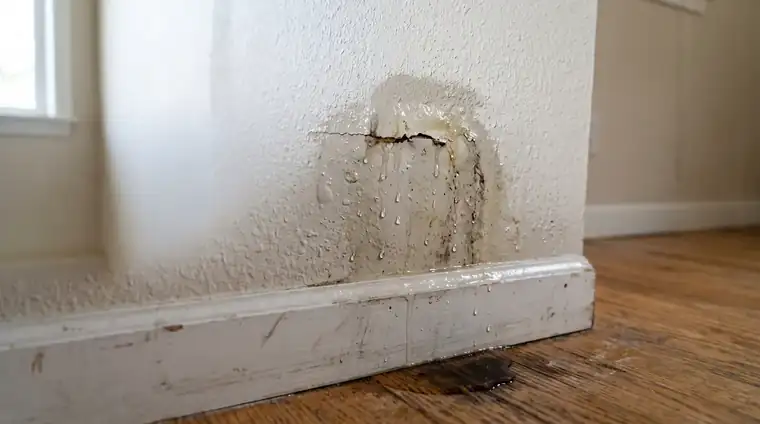
Water leaking inside a stud bay runs down the vertical framing and pools on the wooden bottom plate (sill plate). Drywall and MDF baseboards act like a sponge, wicking that pooled water upward 3 to 12 inches, which causes latex paint to blister and baseboards to swell and separate at mitered corners.
How do you find leaks behind thick lath-and-plaster walls in historic McLoughlin or West Medford homes?
Because 1920s lath-and-plaster is nearly an inch thick and expensive to patch, we rely on contact acoustic listening directly on metallic risers and valves, fixture pressure/drain isolation, and inserting a 6mm flexible video borescope through existing pipe escutcheon openings or behind a detached baseboard before any wall opening is made.
What if the stain on my ceiling feels dry to the touch right now?
A brown water ring can feel dry on the surface if the leak is intermittent—such as an upstairs drain trap, a toilet wax ring that only leaks when flushed, or an AC condensate pan in the attic. Using a deep-sensing pinless moisture meter and running controlled fixture tests upstairs reveals whether the framing above the drywall is still actively wetting.
Can an attic water heater or HVAC unit cause a wall or ceiling leak in Medford?
Yes. In summer, clogged air conditioning condensate drain lines in Medford attics overflow their auxiliary drip pans and stain hallway ceilings. In winter or year-round, homes with attic PEX manifolds or recirculation lines can develop fitting leaks that travel down interior partition walls.
Should I spray bleach or paint KILZ primer over a ceiling stain right away?
Wait until the leak source is identified and the cavity has dried below 15% moisture content. Painting stain-blocking primer over damp drywall traps moisture inside the ceiling cavity, accelerating hidden mold growth on the paper backing of the sheetrock and obscuring moisture meter readings.
Do you patch and paint the drywall after repairing the pipe inside the wall?
As local plumbing and leak detection specialists, we make the smallest, cleanest square drywall cut possible (saving the cut drywall piece when clean) and complete the permanent pipe or drain repair. While we do not perform final cosmetic mudding, texturing, and painting, keeping our access opening small makes any handyman or DIY patch simple and inexpensive.