
Underground Water Line Leak Detection in Medford, OR
When your Medford Water Commission meter spins continuously even after you close the main shut-off valve inside your house, pressurized water is escaping from your buried yard service line. Medford Leak Detectives maps the underground pipe route and pinpoints the break beneath turf, gravel, or concrete driveways so you only dig where necessary.
How Private Underground Water Service Lines Work in Medford, OR
Every residential and commercial property connected to the Medford Water Commission (MWC) receives potable water through a buried pipe called the private water service line. While MWC owns and maintains the street water main and the meter register inside the concrete curb box near the sidewalk or property line, the property owner is responsible for the entire buried pipe from the customer-side meter tailpiece all the way to the building's main shut-off valve.
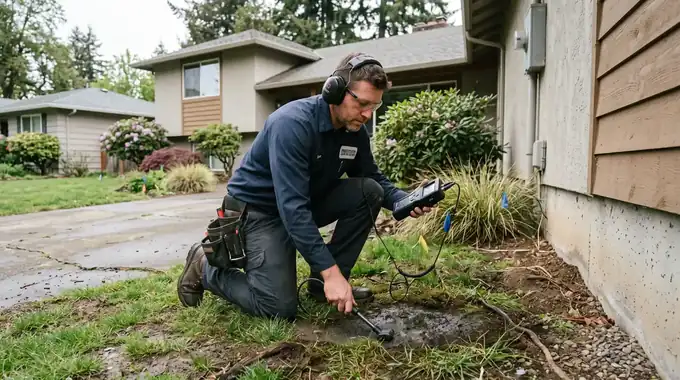
In standard Medford subdivisions, this service line is buried 24 to 36 inches deep and runs 30 to 90 feet beneath front lawns, concrete driveways, retaining walls, or mature trees. On larger parcels in Northwest Medford (Rossanley, Merriman Road), Southwest Medford (South Stage Road), and East Medford foothills, private service lines frequently stretch 150 to 400+ feet. Trenching an entire yard or tearing up an asphalt driveway just to find a single cracked fitting is expensive and unnecessary when electronic locating can isolate the failure spot first.
Why Buried Yard Water Lines Rupture in the Rogue Valley
- Aging Pipe Materials (Galvanized, Polybutylene, PVC & Copper): Homes built before 1965 in West Medford, Liberty Park, and McLoughlin often still have threaded galvanized steel yard lines that rust through at the couplings. Homes built between 1978 and 1995 in North and East Medford frequently used blue or gray polybutylene (PB2110) or thin Schedule 40 PVC yard lines that become brittle from chlorine exposure and split lengthwise.
- Carney & Medford Clay Shrink-Swell Cycles: As heavy Rogue Valley clay soil expands in winter and cracks open during hot July/August droughts, buried rigid pipes and meter riser elbows experience severe bending forces, snapping PVC male adapters at the meter box or house foundation entry.
- Basalt Cobble Abrasion & Tree Root Pressure: Unbedded pipes laid directly against sharp volcanic cobbles vibrate slightly whenever valves open and close (water hammer), wearing through copper or poly walls. Meanwhile, mature oak, pine, and ornamental pear roots wrap around buried pipes, crushing plastic tubing as roots thicken.
- Irrigation Tee & Backflow Connections: Most Medford yard lines have one or more buried tees branching off before the house to feed a Double Check Valve Assembly (DCVA) for lawn sprinklers or hose hydrants. Brass-to-plastic transition fittings at these buried tees are among the most common underground leak points.
Domestic Service Line vs. Irrigation Leak vs. Groundwater: How to Tell the Difference
In Medford, a soggy patch in the yard does not always come from the same water source. Many properties have both pressurized MWC drinking water AND seasonal non-potable water from the Medford Irrigation District (MID) or Rogue River Valley Irrigation District (RRVID). We use a rapid three-valve isolation check to identify the exact system before scanning:
| Isolation Test Step | What You Do | Meter / Yard Observation | What It Proves |
|---|---|---|---|
| 1. Baseline Meter Check | Turn off all indoor taps and sprinkler timers; open the MWC street meter lid | Low-flow red triangle or digital display is moving steadily | Confirms pressurized municipal water is escaping somewhere downstream of the meter |
| 2. House Main Shut-Off Test | Close the main water shut-off valve inside the garage, crawlspace, or utility closet | Meter continues spinning at the exact same rate | Proves the leak is underground outside the house (either the main yard line or an irrigation branch) |
| 3. Irrigation Backflow Shut-Off Test | Close the isolation ball valves inside the yard irrigation backflow box (DCVA) | Meter stops spinning (or continues spinning) | If it stops, the leak is in the sprinkler mainline/valves; if it keeps spinning, the domestic yard service line itself is broken |
| 4. Non-Potable Ditch / Groundwater Check | Meter is completely stationary (0.00 GPM) with all valves open, yet lawn stays muddy | Water pools only during May–September irrigation season or winter storms | Points to non-potable MID irrigation lateral seepage, French drain blockage, or seasonal hillside spring water |
Our 4-Step Underground Pipe Tracing & Leak Pinpointing Process
- Electromagnetic Route & Depth Mapping: For metallic pipes (copper or steel), we clamp a multi-frequency radio transmitter to the meter riser and trace the exact buried line path and depth across the yard. For non-metallic plastic lines (polyethylene, PVC, PEX), we feed a detectable fiberglass fish tape or acoustic pulse generator into the line so we know exactly where the pipe travels.
- Compressed Air & Hydrostatic Pressure Enhancement: A water line buried 3 feet deep in wet clay may not make enough noise at low flow. By regulating compressed air or controlled water pulses into the isolated yard line, we amplify the acoustic signature at the underground fracture.
- Shielded Ground Microphone Sweeps: We walk the traced pipe path at 2-to-3-foot intervals using heavy wind-shielded ground plates and digital frequency filters (100 Hz to 1,200 Hz) that block out street traffic from Crater Lake Highway, I-5, or Barnett Road and measure peak subterranean decibel levels.
- Forming Gas (5% Hydrogen / 95% Nitrogen) Pinpointing: When a leak lies beneath a concrete driveway, paver patio, or deep rocky soil, we purge the line and introduce non-toxic forming gas. Because hydrogen molecules are the smallest in nature, they migrate straight up through soil and concrete seams where our electronic gas sniffer marks the spot within inches.
Spot Excavation Repair vs. Full Service Line Replacement
Once we mark the exact location and depth of your underground leak, our plumbing team helps you choose the most practical repair:
- Targeted Spot Excavation & Coupling Repair: If your service line is modern Type K/L copper, Schedule 80 PVC, or heavy-wall HDPE/PEX and suffered a single localized break (such as a failed tee at the irrigation tie-in, a cracked meter union, or a single rock puncture), we hand-excavate a small 3×3 foot hole at our mark and install code-approved brass pack-joint couplings or expansion fittings.
- Full Service Line Pull / Replacement: If our excavation reveals that the existing yard pipe is brittle gray polybutylene, heavily rusted galvanized steel, or thin-walled white PVC covered in longitudinal stress cracks, patching one spot will often lead to another blowout down the line. In those cases, we can pull or directional-install a continuous, jointless 200-PSI PEX-a or HDPE service line from the meter box to the house with minimal lawn disruption.
Practical Cost Factors & Medford Utility Credit Documentation
Underground water line leak detection in Medford typically is provided with clear upfront estimates for standard residential yard runs (under 100 feet), while acreage properties with long 200-to-500-foot plastic runs or unlabeled ranch laterals are quoted based on line length and tracer gas requirements.
Because underground leaks drain directly into the soil without flooding your living room, they often run for weeks until the Medford Water Commission flags continuous hourly usage or delivers a high monthly bill. After we locate and repair the underground break, we provide a detailed invoice documenting the buried service line failure and post-repair zero-flow meter check so you can submit a leak adjustment request to MWC.
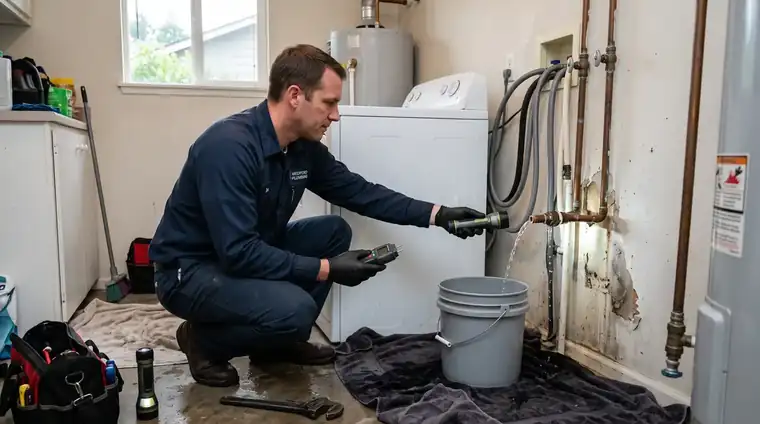
Complete Underground Line Locating, Spot Dig Repair & Service Line Replacement
Medford Leak Detectives handles both subterranean leak detection and underground pipe repair across Medford and Jackson County. You don't have to coordinate a separate locating company and an excavation plumber:
- Surgical Spot Excavations: Hand-digging directly over the pinpointed leak to preserve mature landscaping, walkways, and turf.
- Meter Box & House Riser Rebuilds: Replacing snapped PVC male adapters at the curb meter box and installing brass ball shut-off valves and PRVs at the house entry.
- Full Yard Line Replacements: Upgrading obsolete polybutylene and rusted galvanized service lines to code-compliant copper or continuous PEX-a/HDPE.
Call (541) 906-0245 to schedule underground water line leak detection in Medford, OR.
Underground Water Line Leak Detection in Medford, OR: Frequently Asked Questions
Practical answers about buried yard lines, Medford Water Commission meters, plastic pipe locating, and spot repair vs. replacement.
Why is my Medford water meter spinning when the main shut-off valve inside my house is closed?
Because the house shut-off valve is located at the end of your yard service line where the pipe enters the garage or crawlspace, closing it only shuts off the indoor plumbing. If the street meter still spins with the house valve closed, water is escaping underground between the curb meter box and the house valve.
Can you locate a leak in a plastic (PVC, polybutylene, or PEX) underground water line?
Yes. While plastic pipes do not conduct sound as far as copper or steel, we locate plastic yard line paths using push-rod transmitters or acoustic pulse generators, and then pinpoint the leak using compressed air/water acoustic amplification and 5% hydrogen / 95% nitrogen tracer gas.
Why is there no wet spot in my yard if my underground water line is leaking?
In Medford, water service lines are buried 24 to 36 inches deep, often beneath gravel drive bases, hardpan clay, or concrete walkways. Escaping water frequently follows the original pipe trench gravel downward or drains into a storm trench or sewer lateral ditch without ever bubbling up to the grass surface.
Who is responsible for a leak right inside the water meter box in Medford?
Under Medford Water Commission rules, MWC maintains the street main, the curb stop valve on the street side, and the water meter itself. The property owner is responsible for the pipe starting at the customer-side outlet coupling just past the meter. If water is filling the meter box, we determine which side of the outlet union is leaking.
How do I know if my underground leak is on my main house line or my sprinkler system?
Locate your irrigation backflow preventer box (usually a green rectangular lid in the front or side yard containing two brass quarter-turn handles). Close one of those two handles and re-check your water meter. If the meter stops moving, the leak is in your irrigation mainline or a weeping sprinkler solenoid valve; if it keeps moving, the leak is on the domestic service line.
Can you detect an underground water leak under a concrete or asphalt driveway?
Yes. Acoustic ground plates actually read very well through solid concrete and asphalt because hard pavement transmits acoustic vibrations uniformly above a pressurized leak. We also use hydrogen/nitrogen tracer gas, which rises through control joints and expansion seams to confirm the exact sub-slab driveway coordinate.
When should I repair just the leaking spot versus replacing the whole yard line?
If your pipe is copper, heavy-wall polyethylene, or PEX and failed at a single fitting, irrigation tee, or rock pinch point, a localized 3x3 foot spot excavation repair is by far the most cost-effective choice. If the pipe is gray polybutylene (1978–1995) or heavily corroded galvanized steel, replacing the full run prevents repeat blowouts.
How deep are residential water service lines buried in Medford, Oregon?
Under the Oregon Plumbing Specialty Code, exterior potable water service lines in the Medford area are required to be buried a minimum of 18 to 24 inches below finished grade for frost protection, though lines crossing driveways, ditches, or sloped East Medford lots often lie 30 to 48 inches deep.
How long does underground water line leak detection and spot repair take?
Locating and marking an underground residential service line leak typically takes 1.5 to 2.5 hours. If the leak is accessible in soil or turf, our plumbing technicians can usually excavate the target spot, splice in new brass/copper/PEX fittings, pressure-test the line, and backfill the hole the same afternoon.
Will the Medford Water Commission reduce my bill after an underground leak is repaired?
Medford Water Commission has a leak adjustment policy for customers who experience an unexpected spike from a concealed underground pipe failure and promptly repair it. We provide an itemized diagnostic and repair invoice with before-and-after meter verification that you can submit to MWC customer service.