
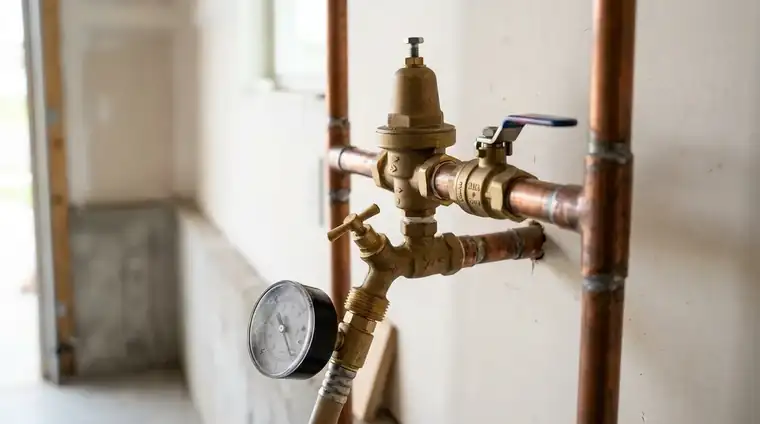
Before replacing faucets or assuming your underground main line is broken, it is important to understand the difference between static water pressure (measured in PSI when no water is running) and dynamic flow volume (how many gallons per minute reach your taps when multiple fixtures are open). Comparing where and when the pressure drop occurs immediately narrows down the culprit.
In This Guide
- Diagnostic Matrix: 5 Causes of Low Water Pressure in Medford Homes
- Clue 1: Is Pressure Low at One Fixture, Hot Taps Only, or the Whole House?
- Clue 2: The Curb Meter Check (Separating a Leak From a Restriction)
- Medford Culprits: Failed PRV Screens vs. 1940s Galvanized Rust Scale
- When Low Water Pressure Signals an Urgent Pipe Rupture
- Frequently Asked Questions
1. Diagnostic Matrix: 5 Causes of Low Water Pressure in Medford Homes
| Where Pressure Is Low | MWC Meter With Taps Off | Most Likely Plumbing Cause | Typical Fix |
|---|---|---|---|
| Only ONE faucet or showerhead | Stationary (0.00 GPM) | Sediment/scale clogging the faucet aerator screen, shower flow restrictor, or single-handle mixing cartridge | Unscrew and clean aerator screen or replace the fixture's internal mixing cartridge |
| HOT water only (across all sinks & showers) | Stationary OR Spinning | If meter spins: active hot-water slab or crawlspace leak. If meter is still: corroded dielectric nipple or partially closed shut-off valve on top of the water heater | Check meter & water heater inlet valve; pinpoint hot slab leak or clear heater outlet restriction |
| WHOLE HOUSE drops suddenly when 1 tap opens | Stationary (0.00 GPM) | Failed Pressure Reducing Valve (PRV) diaphragm or clogged stainless strainer screen inside the PRV body | Test static vs. dynamic PSI at hose bibs; clean strainer or replace brass PRV |
| WHOLE HOUSE has weak flow in a pre-1965 home | Stationary (0.00 GPM) | Internal rust tuberculation inside aging galvanized steel supply pipes narrowing a 3/4-inch pipe to the size of a pencil | Replace constricted galvanized trunk/yard lines with full-flow PEX-a or Type L copper |
| WHOLE HOUSE drops + hissing sound or soggy yard | Spinning rapidly (1.0+ GPM) | Major underground water service line break or split crawlspace/slab main diverting flow before it reaches your taps | Close main valve to confirm; perform electronic acoustic/tracer locating and repair the ruptured pipe |
2. Clue 1: Is Pressure Low at One Fixture, Hot Taps Only, or the Whole House?
- Single Fixture Only: A hidden pipe leak inside a wall rarely causes a pressure drop at just one sink without affecting the adjacent shower or toilet (unless a pipe is kinked or frozen solid). When only one faucet has weak flow—especially right after municipal hydrant flushing or a water repair in your neighborhood—unscrew the small mesh aerator at the tip of the spout and rinse out the sand or mineral flakes.
- Hot Water Only: Go to your kitchen sink and bathroom sink. Run cold water full blast, then switch to hot water full blast. If cold water has strong pressure while hot water is weak throughout the house, walk to your water heater: either a hot-water line is leaking under the slab/crawlspace (stealing flow from the hot manifold), or the galvanized/dielectric outlet nipple on top of the water heater has rusted nearly shut.
- Entire House (Hot and Cold): When every cold and hot tap in the house loses volume simultaneously, the issue lies on the main trunk line between the Medford Water Commission street meter and your primary distribution manifold.
3. Clue 2: The Curb Meter Check (Separating a Leak From a Restriction)
Here is an important physics fact about plumbing: a tiny pinhole leak (0.1 to 0.3 GPM) will NOT noticeably lower the water pressure at your shower, because a 3/4-inch supply pipe carries 12+ gallons per minute. For a leak to noticeably starve your faucets of water pressure, the pipe must be losing 2 to 6+ gallons per minute (such as a split underground service line, a blown crawlspace joint, or a partially frozen/ruptured pipe).
That means if a leak is big enough to cause low water pressure, your Medford Water Commission curb meter will be spinning fast when all indoor taps are turned off! If you check your street meter with all taps off and the low-flow triangle is completely dead still, your low water pressure is caused by a mechanical restriction (like a bad PRV, partially closed valve, or rusted galvanized pipe)—not a leak.
4. Medford Culprits: Failed PRV Screens vs. 1940s Galvanized Rust Scale
- Failed Pressure Reducing Valves (PRVs) in East, North & South Medford: A brass PRV can fail in two ways: it can fail open (letting 100+ PSI street pressure into your house), or its internal spring diaphragm or built-in sediment screen can jam closed. When a PRV jams partially closed, static pressure may look normal for the first 2 seconds when you turn on a faucet, and then immediately drop to a weak 15 PSI trickle!
- Galvanized Steel Pipe Tuberculation in West Medford, Liberty Park & McLoughlin: In Medford homes built before 1965, original galvanized iron pipes accumulate rough, bumpy iron-oxide rust blisters ("tubercles") on the inside wall over 60+ years. A single faucet may flow okay, but the moment someone flushes a toilet while the shower is running, friction loss across the rusted interior starves the shower completely.
5. When Low Water Pressure Signals an Urgent Pipe Rupture
Low Water Pressure & Leak Troubleshooting: Frequently Asked Questions
Can a small pinhole slab leak cause low water pressure throughout my house?
Usually no—a small pinhole leak (0.1 to 0.5 GPM) raises your water bill and creates warm floor spots or hissing sounds, but a 3/4-inch main line easily supplies enough volume to mask that small loss at your faucets. However, if a hot-water slab pipe or underground yard line splits wide open (losing 3 to 8 GPM), you will notice an immediate drop in household water pressure.
Why do I have great water pressure for 2 seconds when I turn on the faucet, and then it drops to a weak stream?
That '2-second burst followed by a drop' is the textbook signature of a failing Pressure Reducing Valve (PRV) or a nearly closed main gate valve. While the faucet is off, water slowly creeps past the restriction and builds static pressure in the pipes; as soon as you open the tap, that stored pressure vents in 2 seconds and the choked valve cannot keep up with dynamic flow.
Why did my outdoor garden hose bibs keep strong pressure while all the faucets inside my house went weak?
In many Medford homes, the front exterior hose bib is plumbed into the main water line BEFORE the Pressure Reducing Valve (PRV) or water softener. If the outdoor hose bib blasts at 85 PSI while every indoor faucet is weak, your PRV or water softener bypass screen right downstream of that hose bib is clogged or failing!
What if my water pressure dropped right after someone worked on the plumbing or turned the main valve off and on?
Two things commonly happen when an old main valve is turned off and back on: (1) an old round-wheel brass gate valve stem snaps internally, leaving the brass wedge dropped down blocking 80% of the pipe; or (2) turning the water back on dislodges a flake of rust or mineral scale that travels downstream and plugs the strainer screen in your PRV or faucet aerators.
Can Medford Leak Detectives test my water pressure and replace a failed PRV or leaking yard line?
Yes. We test static and dynamic PSI across your exterior spigots, PRV, and interior fixtures, verify your water meter for hidden leaks, and carry replacement commercial-grade brass PRVs, quarter-turn ball valves, and pipe repair supplies on every truck.
Experiencing Sudden Low Water Pressure in Medford?
Whether it's a failing PRV, a split underground service line, or corroded crawlspace piping, our technicians can test and restore your water pressure. Call Medford Leak Detectives at (541) 906-0245 or explore our water leak detection service.
Call (541) 906-0245