
Acoustic Leak Detection in Medford, OR
When pressurized water escapes through a pinhole or cracked joint, friction at the pipe wall and turbulence in the surrounding soil or concrete generate continuous acoustic vibrations between 100 Hz and 2,500 Hz. Medford Leak Detectives uses digital frequency-filtered ground microphones, piezoelectric contact rods, and compressed-air enhancement to isolate pressurized water leaks across Medford, OR.
How Electro-Acoustic Leak Detection Works Physically
Acoustic leak detection is an electronic diagnostic method that locates hidden leaks in pressurized water systems by amplifying and filtering the mechanical vibrations created when water or air escapes through a pipe defect. Every pressurized leak generates two distinct types of sound energy:
- Structure-Borne Pipe Wall Vibration (500 Hz – 2,500+ Hz): As water jets through a narrow pinhole or cracked solder joint at 50 to 100 PSI, friction makes the pipe wall itself vibrate like a reed. In rigid metallic pipes (copper and galvanized steel), this high-frequency hiss travels tens of feet along the pipe and can be picked up at exposed angle stops, hose bibs, and manifold risers using a piezoelectric contact rod.
- Ground- and Slab-Borne Impact Noise (100 Hz – 800 Hz): Outside the pipe, the escaping water jet strikes surrounding sand, gravel, clay soil, or the underside of a concrete slab, creating a lower-frequency thrum or circulation rumble. Because soil and concrete absorb high frequencies quickly, this low-frequency signature is strongest directly above the leak point and drops off sharply just a few feet away.
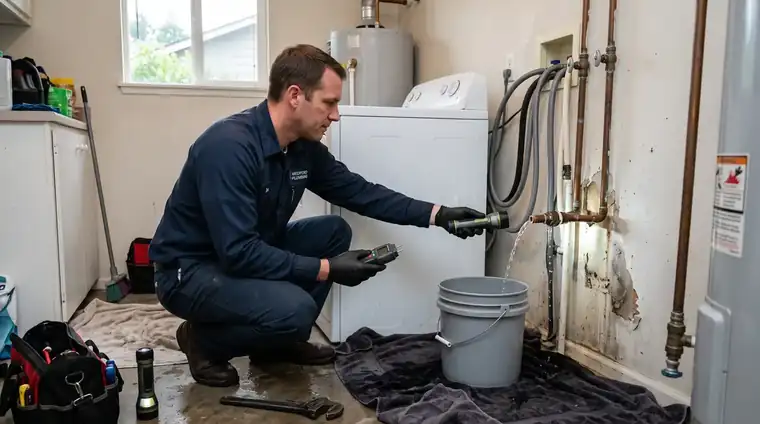
How Pipe Material, Pressure & Medford Soil Affect Acoustic Signals
One reason DIY stethoscopes or inexperienced operators mislocate leaks is that different pipe materials and Rogue Valley soil conditions transmit sound at completely different frequencies and distances:
| Pipe / Ground Condition | Typical Frequency Band | Signal Transmission Distance | How We Optimize the Acoustic Scan |
|---|---|---|---|
| Copper & Galvanized Steel Pipes | 600 Hz – 2,400 Hz (crisp metallic hiss) | Long (30 to 100+ feet along the pipe wall) | First triangulate between two metallic touch points, then switch to a floor/ground plate to find the peak low-frequency impact spot |
| PEX, PVC & Polybutylene Plastic Pipes | 150 Hz – 600 Hz (low muffled whoosh) | Short (sound attenuates within 3 to 10 feet in plastic walls) | Trace the buried pipe route closely and introduce regulated compressed air/water pulses (or forming gas) to create a strong local acoustic pop |
| 4-to-6 Inch Concrete Foundation Slabs | 300 Hz – 1,200 Hz | Uniform coupling across hard tile or bare concrete | Wait for water heater and HVAC blowers to cycle off; take 12-inch grid decibel readings directly along the electromagnetically traced pipe line |
| Medford Expansive Adobe Clay vs. Gravel | 100 Hz – 500 Hz in wet clay; 400 Hz – 1,000 Hz in gravel | Wet saturated clay dampens sound; rocky backfill rattles clearly | Use heavy wind-shielded ground bells with high-pass/band-pass filters to cut out low-frequency traffic rumble from I-5 and Hwy 99 |
Why Loud Sound at a Faucet Does Not Mean the Leak Is Right at That Wall
A common question on homeowner forums is: "I hear loud rushing water at my hallway bathroom toilet shut-off valve, so why did the technician mark the leak 12 feet away in the kitchen?"
Because copper tubing is a rigid metal waveguide, a sub-slab pinhole 12 feet away transmits vibration along the buried pipe and radiates it loudly into the air wherever the pipe stubs up out of the concrete and attaches to thin drywall! If you break the wall at the noisy toilet valve without scanning the slab path with a floor plate and thermal camera, you will only find intact vertical copper riser pipe. By comparing contact-rod decibel readings against surface-plate impact readings along the entire loop, Medford Leak Detectives separates transmitted pipe resonance from the true subterranean leak point.
Step-by-Step: How an Acoustic Leak Investigation Proceeds
- Ambient Noise Suppression & Pressure Verification: We verify system pressure (ideally 50–80 PSI; acoustic signals drop sharply below 20 PSI) and temporarily pause refrigerators, ice makers, pool pumps, and forced-air furnaces.
- Contact-Probe Survey at Fixture Risers: Using a steel contact probe on every angle stop, hose bib, water heater union, and manifold header, we log digital signal levels (0–99 scale) to bracket which pipe segment carries the strongest vibration.
- Electromagnetic Pipe Path Mapping: Before listening through a floor or lawn, we trace the exact underground path of the target pipe so our surface sensor sits directly over the pipe axis—moving even 18 inches off-center on a deep line cuts acoustic signal strength in half.
- Surface-Plate & Ground-Bell Pinpointing: We step along the traced pipe path with a flat brass floor transducer (for indoor tile, hardwood, or concrete) or a tripod ground microphone (for turf and gravel), narrowing the peak low-frequency spectrum to a 12-to-18-inch circle.
- Cross-Verification With Thermal or Tracer Gas: Whenever pipe depth, saturated clay, or plastic pipe material creates any ambiguity, we cross-check the acoustic mark with FLIR infrared thermography or 5% hydrogen / 95% nitrogen tracer gas before recommending an access cut or repair.
When Acoustic Equipment Alone Is Not Enough (Realistic Limitations)
Honest diagnostics means knowing when acoustic listening works best and when another method must take over:
- Unpressurized Drain & Sewer Lines: Gravity drains, toilet wax rings, and shower pans do not carry static water pressure, so they do not hiss. Those require sewer camera inspection, hydrostatic drain plug testing, and moisture/thermal scanning.
- Very Slow Seepage Weops (< 0.05 GPM): A microscopic joint weep that loses only a cup of water per hour may not generate enough turbulence to hear through 4 inches of concrete. Draining the line and pressurizing it with forming gas (hydrogen/nitrogen) solves this immediately.
- Fully Flooded Pipe Trenches: When a buried pipe has been leaking for weeks inside a waterlogged clay cavity, the water jet is submerged underwater ("drowned jet"), which muffles high frequencies. Introducing compressed air pulses creates distinct acoustic bubbling that ground microphones pick up clearly.
Acoustic Listening & Tracer Gas Leak Detection Medford Services
When a sub-slab or deep underground leak is too quiet for acoustic listening alone, we pair ultrasonic ground microphones with safe gas leak detection Medford tracer gas diagnostics. In plumbing leak detection, gas leak detection services use an non-flammable, food-grade blend of 5% hydrogen and 95% nitrogen introduced into the isolated water pipe; the tiny hydrogen molecules escape through pinhole cracks, rise through concrete or clay soil, and trigger our electronic sniffer probe at the exact surface coordinate. (Note: if you smell rotten-egg mercaptan odor from a natural gas fuel line or appliance, exit the building immediately and call Avista Utilities at 800-227-9187.)
Acoustic Leak Pinpointing + complete Plumbing Repair
Medford Leak Detectives combines industrial electro-acoustic instrumentation with plumbing repair across Medford and Jackson County:
- Sub-Slab & Buried Mainline Acoustic Pinpointing: Digital band-pass filtering to isolate leaks even near busy Downtown Medford, Barnett Road, and Hwy 99 corridors.
- Air-Pulse & Tracer Gas Backup Included: If a plastic pipe or deep leak is too quiet for passive listening, we carry compressed air manifolds and tracer gas sniffers on the same truck.
- Immediate Pipe Repair & Rerouting: Spot soldering, PEX-a overhead reroutes, and yard line splices completed right after pinpointing.
Call (541) 906-0245 to schedule acoustic leak detection in Medford, OR.
Acoustic Leak Detection in Medford, OR: Frequently Asked Questions
Technical and practical answers on how acoustic leak detectors work, why pipe material matters, and how we handle noisy environments.
Can acoustic leak detection equipment hear every hidden pipe leak?
Acoustic equipment excels at locating pressurized supply leaks where escaping water or compressed air creates turbulence (typically 30+ PSI). However, unpressurized drain leaks, slow pinhole weeps, or deep plastic pipes in wet clay may produce a weak acoustic signal, which is why we also carry infrared thermal cameras, moisture meters, and hydrogen/nitrogen tracer gas on every service call.
Why does a small pinhole leak often sound louder on acoustic equipment than a huge broken pipe?
A small pinhole under 65 PSI acts like a high-velocity whistle or pressure-washer nozzle, creating intense, high-frequency pipe vibration and soil turbulence. By contrast, if a pipe snaps completely in half underground, water pressure at the break drops near zero and water simply pours out with very little friction hiss—requiring compressed air injection to generate a loud acoustic bubble.
Does acoustic leak detection work on PEX and PVC plastic pipes?
Yes, with a different technique than copper. Because soft plastic absorbs high-frequency vibrations within a few feet, we trace the exact path of the PEX or PVC pipe first, listen using low-frequency band-pass filters (150 Hz–500 Hz), and often introduce regulated compressed air pulses or tracer gas so the break is unmistakably clear.
How do you block out street traffic noise in Downtown Medford or near I-5 during an acoustic test?
Professional electro-acoustic amplifiers include digital band-pass and notch filters plus minimum-level profiling. Because tire noise and footsteps are transient (rising and falling every few seconds) while a pressurized water leak produces a constant, uninterrupted baseline frequency, our processor locks onto the steady baseline minimum and filters out wind and traffic spikes.
Can you listen through carpet, hardwood, or tile without removing the flooring?
Hardwood, ceramic tile, luxury vinyl plank (LVP), and bare concrete transmit acoustic vibrations directly to a flat brass floor transducer without removing the floor. Thick plush carpet and foam padding absorb sound like an acoustic blanket, so in carpeted rooms we either probe down through the carpet weave to touch the slab or rely on thermal imaging and tracer gas.
Is acoustic leak detection only used for underground and slab pipes?
No. Contact acoustic rods are also used indoors on exposed angle stops, shower stems, manifold headers, and baseboard trim to rapidly determine which wall cavity or floor joist bay contains a hissing supply pipe before opening any drywall.
What should I turn off in my house before an acoustic leak inspection?
To get the cleanest acoustic reading, it helps to pause dishwashers, washing machines, automatic ice makers, humidifiers, aquarium pumps, and swimming pool pumps, and avoid running faucets during the 45-to-90-minute listening scan.
Why did I hear water running in my bathroom wall when the leak was actually outside in the yard?
Because your copper or steel main service line enters the house and connects directly to your interior copper pipes, the loud vibration of an underground leak 20 feet out in the front yard travels right up the metal pipe into your walls. Closing the main house shut-off valve and checking the street meter immediately tells us whether the sound originates inside or outside.
How deep underground can acoustic ground microphones detect a water leak?
Under normal Medford water pressures (50 to 90 PSI), shielded ground microphones routinely detect metallic water line leaks buried 3 to 6 feet deep beneath soil, asphalt, or concrete. For deeper lines or quiet plastic pipes, pairing acoustic listening with hydrogen/nitrogen tracer gas extends reliable detection even further.
Does an acoustic leak inspection damage my pipes or plumbing fixtures?
Not at all. Acoustic sensors simply rest against the outside of valves, floors, walls, and soil. Even when we perform air-pulse or tracer-gas enhancement, pressure is carefully regulated at or below your normal household operating pressure (typically 40 to 60 PSI).
What is the difference between plumbing tracer gas leak detection Medford and natural gas utility leaks?
Plumbing tracer gas leak detection services use a completely safe, non-toxic 5% hydrogen / 95% nitrogen gas mixture injected into drained water or sewer lines to pinpoint tiny subterranean water leaks. For natural gas fuel line odors or gas meter emergencies in Medford, always call Avista Utilities at (800) 227-9187 first.