
McLoughlin Historic District Leak Detection in Medford, OR
Medford's landmark McLoughlin Historic District—encompassing the tree-lined avenues around South Oakdale Avenue, Holly Street, King Street, Reddy Avenue, Geneva Avenue, and East Main Street—contains some of Southern Oregon's finest 1890s–1930s Craftsman, Queen Anne, Colonial Revival, and Bungalow residences. Medford Leak Detectives uses preservation-focused acoustic, thermal, and micro-borescope diagnostics to locate concealed leaks while protecting original lath-and-plaster walls, Douglas fir floors, and box-beam ceilings.
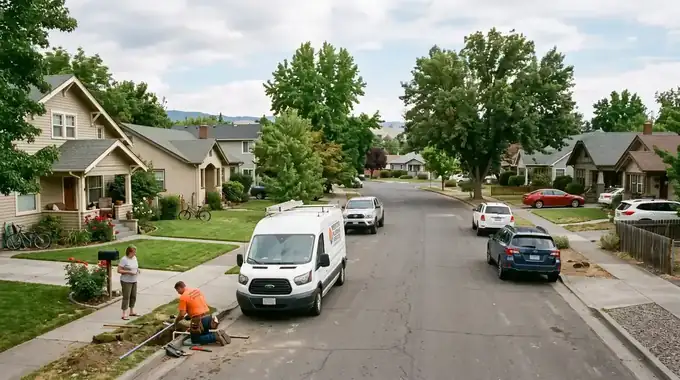
Why Historic McLoughlin Homes Demand Preservation-Grade Leak Diagnostics
In a modern tract home with standard 1/2-inch gypsum drywall and latex paint, cutting an exploratory hole in a wall is an annoyance. In a 1912 Craftsman or Four-Square home on South Oakdale Avenue, King Street, or Geneva Avenue in the McLoughlin Historic District, cutting blindly into a wall or ceiling can destroy irreplaceable quarter-sawn oak wainscoting, hand-troweled lime plaster over old-growth wood lath, vintage subway tile, or original heart-pine and Douglas fir strip flooring.
Medford Leak Detectives approaches every historic Medford residence with a strict preservation mindset: we exhaust every electronic, acoustic, thermal, pressure-isolation, and micro-borescope method from basements, attics, and existing valve trim openings before a single inch of historic finish is ever touched.
Common Plumbing Systems & Failure Points in 1890s–1930s Medford Homes
| Historic Plumbing System | Typical Location in McLoughlin Homes | How It Fails Over Time | Preservation-Focused Diagnostic & Repair |
|---|---|---|---|
| Original Galvanized Steel & Early Brass Supply Risers | Vertical chases feeding second-story bathrooms and butler's pantries behind lath-and-plaster walls | Internal rust scale pinholes at threaded 90° elbows or galvanic corrosion where retrofitted copper meets old steel | Contact acoustic probing + micro-borescope inspection through fixture escutcheons; fish flexible PEX-a through existing wall chases from basement to attic |
| Upstairs Clawfoot Tubs, Drum Traps & Lead/Cast-Iron Bends | Second-floor bathrooms situated directly above formal dining rooms or living room box-beam ceilings | Corroded lead closet bends, soldered brass drum traps weeping at cleanout threads, or dried-out standing waste gaskets | Sequential fixture dye & trap testing (without running supply pressure) + FLIR thermal ceiling scan to isolate the exact drain fitting |
| Full or Partial Concrete Basements & Service Entries | Basement mechanical areas where the street water main enters through poured concrete or stone foundation walls | Weeping main gate valves, corroded meter-to-basement galvanized/copper service pipes, or winter groundwater seepage | Hydrostatic pressure isolation + chlorine/meter testing to separate pressurized service line leaks from seasonal foundation groundwater |
| Century-Old Vitrified Clay Tile Sewer Laterals | Buried 4 to 8 feet deep beneath historic brick walkways, front porches, and 100-year-old oak/maple/elm street trees | Mortar joints dissolved long ago; dense root masses and offset clay bells cause basement floor-drain backups | Self-leveling HD sewer camera scope + 512 Hz radio sonde depth mapping to evaluate trenchless lining vs. surgical spot excavation |
Fishing New Piping Through Historic Wall Chases Without Opening Plaster
One of the biggest advantages of two-story Craftsman and Victorian homes in the McLoughlin district is that original plumbers often ran vertical water risers and cast-iron vent stacks inside a dedicated plumbing chase extending straight from the open basement up to the attic.
When our acoustic and pressure testing confirms that a vertical hot or cold supply riser inside a plaster wall has developed a pinhole leak, we can frequently disconnect the old pipe in the basement and at the upstairs vanity or closet access panel, abandon the leaking riser in place, and fish a continuous, jointless PEX-a supply line right up the vertical chase—restoring full water pressure with zero damage to your lath-and-plaster walls.
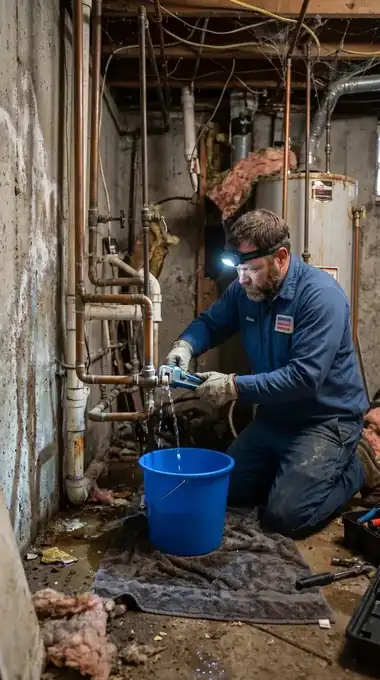
Preservation-Minded Leak Detection & Complete Plumbing for McLoughlin Homes
Medford Leak Detectives protects Medford's architectural heritage while solving complex water and drain leaks:
- Lath-and-Plaster & Hardwood Preservation: Micro-borescope cameras, FLIR thermal imaging, and vertical chase fishing that avoid destructive wall cuts.
- Flameless ProPress & PEX-a Retrofits: Zero open soldering flames inside century-old wood framing bays.
- 512 Hz Sewer Camera & Yard Line Pinpointing: Mapping buried water and clay sewer lines under mature trees and historic hardscaping.
Call (541) 906-0245 for McLoughlin Historic District leak detection and repair.
Services & Guides for McLoughlin Historic District Property Owners
For McLoughlin's historic architecture, basements, lath-and-plaster walls, and century-old clay sewer laterals, review these dedicated resources:
Primary Diagnostic & Repair Services in McLoughlin Historic District
- Lath-and-Plaster Wall & Ceiling Leak Detection — Tracing upstairs bathroom risers, clawfoot tub drains, and radiator/supply leaks without blind plaster demolition.
- Historic Clay & Cast-Iron Sewer Camera Inspection — HD video scoping and 512 Hz locating for century-old vitrified clay laterals under mature street trees.
- Underground Yard Line Leak Detection — Locating deep service line breaks beneath brick walkways, carriage driveways, and mature landscaping.
- Basement & Crawlspace Water Leak Detection — Separating domestic pipe leaks from basement foundation seepage.
Recommended Homeowner Guides
- Ceiling Water Stain: Is It a Plumbing Leak or a Roof Leak?
- When Should You Get a Sewer Camera Inspection in Medford, OR?
- Electronic Leak Detection vs. Traditional Plumbing Demolition
- Low Water Pressure in One or More Fixtures: Could It Be a Leak?
Explore Nearby Medford Service Areas
View our all Medford neighborhoods overview or contact our Poplar Drive dispatch office at (541) 906-0245.
McLoughlin Historic District Leak Detection & Plumbing FAQs
Answers to local questions from homeowners and property managers in McLoughlin Historic District (97501 & 97504).
Can a thermal camera and moisture meter read through thick lath-and-plaster walls in a 1915 Craftsman home?
Yes, with proper calibration. Because traditional lime plaster over wood lath is roughly 3/4-inch to 1-inch thick, it has higher thermal mass than modern drywall, producing a broader, softer evaporative cooling signature on a FLIR camera. Pairing thermal scans with deep-field capacitance moisture meters and contact acoustic probes on metal valve stems locates the wet framing bay accurately without cutting plaster.
How do you repair a leaking upstairs bathroom pipe without ruining a formal dining room ceiling below?
First, we determine whether the leak is on the pressurized supply riser or the tub/toilet drain trap. For supply risers, we can often fish a new continuous PEX-a line from the basement up through the wall chase or access the valve from the back of an upstairs closet. For drain traps, accessing from an upstairs closet panel or lifting a single tongue-and-groove subfloor board inside a vanity cabinet often keeps the ornate plaster ceiling below 100% untouched.
What is a 'drum trap' in an older McLoughlin bathroom, and why does it leak?
Many Medford homes built before 1945 used a cylindrical metal 'drum trap' (made of lead or brass with a threaded cleanout lid) beneath bathtubs instead of a modern curved P-trap. Over 80+ years, the bottom of the lead/brass drum corrodes through or the threaded cap gasket seeps whenever the tub drains, staining the first-floor ceiling below.
Why shouldn't you use an open torch to solder copper pipes inside a historic McLoughlin wall cavity?
Century-old timber framing in historic Medford homes is bone-dry and often contains wood-shaving insulation, dust, or old tar paper inside balloon-framed stud bays that run uninterrupted from the basement to the attic. We use hydraulic ProPress copper crimping and cold-expansion PEX-a fittings so an open flame is never introduced into your walls.
How can we tell if water in our McLoughlin basement is a leaking service pipe or winter groundwater?
We check your Medford Water Commission curb meter and perform a sealed hydrostatic pressure test on the domestic water line entering your basement. If the meter is stationary and the pressure gauge holds steady, the water entering through the basement floor/wall joint is seasonal hydrostatic groundwater rather than a plumbing leak.
Can you scope our 100-year-old clay sewer line without digging up our front porch or heritage trees?
Yes. We run a self-leveling HD video camera through the basement or yard cleanout all the way to the city sewer main and use our 512 Hz radio sonde receiver to map the exact path and depth of the clay lateral—showing you which joints have root intrusion and whether trenchless lining or a small targeted spot repair is best.