
Frequently Asked Questions About Leak Detection in Medford, OR
Direct, practical answers to help Medford and Jackson County property owners check their Medford Water Commission meter, understand electronic diagnostic costs, compare slab reroutes against spot repairs, and navigate utility bill adjustments.
Quick-Reference Medford Leak Triage Table
Use this cheat sheet to check the most common water leak scenarios in Medford before reading the full Q&A below:
| Question Topic | Quick Answer Summary | Detailed Guide / Service Link |
|---|---|---|
| Sudden High Water Bill | Check curb meter with taps off; running toilets, yard lines, and slab leaks waste 3,000–6,000+ gal/mo. | High Bill Troubleshooting |
| Hearing Water Running Behind Walls | Shut main valve immediately; acoustic & thermal imaging pinpoints pipe break without cutting sheetrock. | Wall & Ceiling Diagnostic |
| Warm or Hot Spot on Floor | Classic hot-water slab leak under foundation; close water heater intake valve to confirm isolation. | Slab Leak Service |
| Testing the Curb Water Meter | Turn off all indoor taps & sprinklers; watch MWC low-flow red triangle or digital flow for 2 minutes. | Step-by-Step Meter Guide |
| Indoor vs. Yard Line Isolation | Close house main valve: if meter stops, leak is inside/slab; if meter spins, leak is in the yard. | Underground Yard Line Service |
| Silent Toilet Leak Check | Drop food coloring into tank; if color enters bowl without flushing, replace the worn rubber flapper. | Fixture Leak Guide |
| Fixing Slab Leaks Without Breaking Floors | Abandon failing copper under concrete; route new insulated PEX-a overhead through walls and attic. | Slab Leak & PEX Reroute |
| Emergency Burst Pipe First Steps | Shut main valve in garage/utility room, open lowest outside tap to drain pressure, shut off water heater. | Emergency Repair Guide |
Common Everyday Leak Questions & Direct Answers
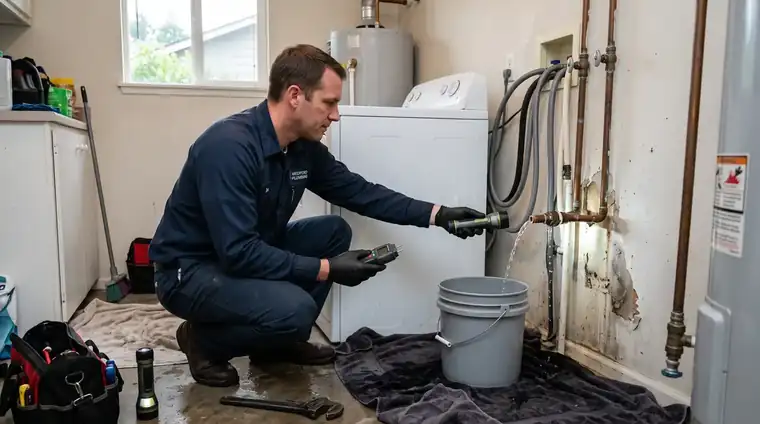
Why is my water bill suddenly so high when my water usage hasn't changed?
A sudden, unexplained spike in your water bill almost always points to a silent running toilet flapper, an underground yard service line fracture, or a sub-slab plumbing loop leak escaping 24/7.
In Medford, a hidden pinhole leak as small as 1/32 of an inch wastes over 3,000 to 6,000 gallons per month. To confirm if you have an active leak, check your Medford Water Commission (MWC) curb meter with all household taps closed. If the low-flow dial or digital flow rate is moving, water is escaping under pressure. Medford Water Commission also offers a courtesy leak adjustment to reduce abnormal bills once an underground or slab leak is repaired by a professional plumbing contractor.
Why do I hear water running behind my walls or floor when all faucets are turned off?
A continuous hissing, rushing, or humming noise when no plumbing fixtures are in use indicates pressurized water escaping through a cracked pipe or pinhole leak inside a wall cavity, crawlspace, or foundation.
If you hear this sound, immediately shut off your home's main water valve to prevent structural drywall and framing damage. Professional electronic leak detection uses ultrasonic acoustic listening probes and thermal imaging cameras to locate the exact sound and temperature signature through walls and concrete without cutting exploratory holes.
Why is there a warm or hot spot on my concrete floor?
A localized warm or hot area on tile, laminate, luxury vinyl, or carpet flooring is the classic indicator of a hot-water slab leak running beneath your concrete foundation.
When an underground copper hot-water line develops a friction pinhole leak, continuous escaping hot water heats the concrete foundation slab and radiates through the finished floor. Additional warning signs include your water heater running or firing continuously and higher gas or electric utility bills. Shutting off the cold inlet valve on top of your water heater will immediately stop the leak if it is on the hot-water loop.
How do I check my water meter to see if I have a hidden leak?
Shut off every indoor faucet, appliance, and outdoor sprinkler zone, then inspect the low-flow leak indicator on your municipal meter box at the street curb.
For Medford Water Commission meters: (1) Turn off all water inside and outside the home; (2) Open the concrete meter box lid at the curb; (3) Clean the glass face and look for the small red triangle, blue snowflake, or digital flow rate display; (4) Watch it closely for 2 minutes. If the indicator moves or shows any flow greater than 0.00 GPM while all water is shut off, pressurized water is actively leaking somewhere on your property.
How can I tell if a water leak is inside my house, under the concrete slab, or out in my yard?
You can isolate the leak location in minutes using the 3-valve isolation test by shutting off your house main valve and observing whether the street meter stops spinning.
First, locate and close your home's main water shut-off valve (typically in the garage or utility closet). If the street curb meter stops spinning, the leak is located inside the house or under your concrete slab. If the street meter continues spinning with the house valve closed, close the shut-off handle inside your green yard irrigation backflow box (DCVA). If the meter stops now, your sprinkler mainline is leaking; if it continues spinning, the break is in your underground domestic yard line between the city meter and the foundation.
Can plumbers find hidden water leaks without cutting open walls or breaking concrete?
Yes, specialized electronic leak detection locates concealed pipe leaks with pinpoint accuracy within inches completely non-invasively.
Diagnostic technicians combine four specialized tools: (1) sensitive hydrostatic pressure gauges to isolate which branch line is failing, (2) electromagnetic transmitters to map buried pipe paths and depths, (3) frequency-filtered ultrasonic listening probes to hear escaping water turbulence, and (4) infrared thermal imaging and non-flammable tracer gas to detect thermal differentials and micro-leaks through solid concrete, tile, and drywall.
Who is responsible for fixing a broken underground pipe between the street meter and the house?
In Medford, the property owner is responsible for the entire private water service line starting immediately past the municipal curb meter coupling to the home.
Under Medford Water Commission regulations, the utility is responsible only for the main line in the street and the meter itself inside the curb box. As soon as water leaves the meter coupling on the customer side, all underground piping through your yard, driveway, or landscaping is private property and requires a professional plumbing contractor for repairs.
Does homeowners insurance pay for water leak detection and pipe repairs in Oregon?
Most Oregon homeowners insurance policies cover electronic leak detection, structural tear-out access to reach the broken pipe, and resultant water damage restoration for sudden and accidental leaks.
Standard insurance policies cover the expensive aspects: professional leak locating, opening drywall or concrete to access the pipe ('tear-out'), drying, and restoring damaged flooring, drywall, and baseboards. The replacement plumbing fitting or small section of pipe itself is typically considered routine maintenance and paid out-of-pocket. Always request a detailed written diagnostic report and photos for your insurance claims adjuster.
Why is my yard soggy or muddy when it hasn't rained and my sprinklers are off?
A persistent wet or muddy patch of lawn during dry weather usually signals a cracked underground water service line, a broken sprinkler mainline, or Medford Irrigation District ditch seepage.
To identify the water source, check your Medford Water Commission meter at the curb while all indoor faucets are closed. If the meter is spinning, you are losing pressurized potable city water from your yard service line or sprinkler line. If the meter remains completely motionless (0.00 GPM) between May and September, the moisture is unmetered agricultural canal water from MID or RRVID ditches or seasonal groundwater.
What should I do immediately if a pipe bursts in my Medford home?
Immediately turn off your home's main water shut-off valve, open the lowest outdoor faucet to relieve pressure, shut off your water heater, and call an emergency plumbing contractor.
In most Medford homes, the main shut-off valve is located in the garage, utility room, or crawlspace access door. If water is pooling near electrical outlets, appliances, or breaker panels, turn off electricity to that zone from the main breaker before stepping in standing water. Once water is shut down, take photos of all damage for insurance before cleanup begins.
Will the Medford Water Commission lower my water bill after I repair a hidden leak?
Yes, Medford Water Commission offers a courtesy leak adjustment program that reduces excessive billing charges caused by concealed, underground, or sub-slab pipe leaks.
To qualify for an adjustment, the leak must have been hidden (such as under concrete, in a crawlspace, or underground in the yard), and repairs must be completed promptly by a professional plumbing contractor. We provide complete before-and-after meter verification readings and an itemized repair invoice that you can submit directly to Medford Water Commission customer service for your credit.
What is better for a slab leak: jackhammering the floor for a spot repair or an overhead PEX reroute?
For homes with copper pipes over 15 to 20 years old, an overhead PEX reroute through walls and attic spaces is almost always superior to jackhammering the floor.
Jackhammering concrete ruins expensive flooring (hardwood, tile, or stone) and only patches a single pinhole while leaving the rest of the deteriorating copper under concrete to leak again later. An overhead PEX-a reroute permanently abandons the failing sub-slab line, keeps your flooring completely intact, and eliminates the risk of future slab leaks in corrosive Medford soils.
Why do homes in East Medford and Southeast Medford (97504) get so many copper slab leaks?
Elevated gravity-fed municipal water pressure reaching 85 to 120+ PSI in the East Medford foothills rapidly erodes aging copper plumbing whenever Pressure Reducing Valves fail.
Neighborhoods climbing toward Roxy Ann Peak, Barnett Road, Hillcrest, and North Phoenix Road sit in high-pressure gravity zones. Oregon Plumbing Code requires household water pressure to stay under 80 PSI. When a brass Pressure Reducing Valve (PRV) wears out after 8 to 12 years, high water pressure and hydraulic shock rapidly erode copper pipe elbows and manifolds under concrete slabs from the inside out.
Why is my home's water pressure suddenly low in all faucets and showers?
A sudden whole-house drop in water pressure is usually caused by a major rupture on your underground main supply line, a failed Pressure Reducing Valve (PRV), or a partially closed main gate valve.
To diagnose: check your curb meter. If the meter is spinning at high speed with all faucets off, a underground supply pipe has burst in your yard. If the meter is stationary but water barely trickles from indoor faucets, your home's Pressure Reducing Valve has likely experienced internal diaphragm collapse and needs replacement.
How do I know if my swimming pool is leaking or if water is just evaporating in the summer?
Use the simple 24-hour pool bucket test to accurately distinguish natural hot-weather evaporation from an active swimming pool plumbing or structural leak.
In Medford's hot July and August weather (95°F–105°F), uncovered pools normally lose about 1/4 to 3/8 of an inch per day to evaporation. To test: place a 5-gallon bucket filled with pool water on the top pool step, mark the water level inside and outside the bucket with waterproof tape, and check after 24 hours. If the pool water drops significantly more than the bucket water, your pool has an active leak in its skimmer, return lines, or shell.
Can you repair the broken pipe on the same visit after locating the leak, or do I need another plumber?
Yes, we provide turnkey same-visit repairs immediately upon locating the leak so you never have to search for a second contractor.
Unlike locate-only diagnostic companies that simply mark an 'X' on your concrete floor and leave you without water, our service vans carry Type L copper, ProPress tools, Uponor PEX-a piping, Pressure Reducing Valves, and underground repair couplings to complete emergency spot repairs or overhead reroutes on the spot.
What causes water pipes to freeze and burst in Medford during the winter?
Severe winter temperature inversions dropping night temperatures to 12°F–22°F freeze water inside uninsulated crawlspace pipes, outdoor hose bibs with hoses attached, and unheated garages.
Water expands by roughly 9% when it freezes, creating immense hydraulic pressure that splits copper and PVC pipes along their seams. In Medford, you can prevent frozen pipes by disconnecting garden hoses before freezing weather arrives, closing foundation crawlspace vent louvers, and insulating exterior backflow prevention assemblies.
When should I get a sewer video camera inspection done?
You should schedule a sewer camera inspection if you experience recurring drain clogs, gurgling toilets, sewer gas odors indoors, or before purchasing an older home.
Older Medford neighborhoods (such as Downtown, West Medford, and the McLoughlin Historic District) frequently have original clay tile, cast iron, or fragile Orangeburg sewer lines that are prone to aggressive tree root penetration, bellies, and joint misalignments. A high-resolution color camera with 512 Hz radio transmitter accurately maps the exact problem and depth without digging up your yard.
Why does my bathroom or laundry room smell musty if I don't see any standing water?
A persistent musty or damp odor without visible standing water is a prime indicator of a slow pinhole leak hidden behind drywall, under vinyl flooring, or inside a dark crawlspace.
Slow leaks from shower valves, toilet wax rings, washing machine supply boxes, or drain vent pipes frequently soak insulation and wood framing out of sight, promoting rapid black mold growth. Specialized infrared thermal cameras and radio-frequency moisture meters can detect and map these concealed wet pockets before structural rot or toxic mold spreads.
How do I know if my toilet is leaking silently?
Place several drops of dark food coloring into the toilet tank and wait 15 minutes without flushing; if colored water seeps into the bowl, you have a silent flapper leak.
A deteriorating rubber flapper or improperly adjusted fill valve allows water to continuously drain into the sewer overflow tube without making noticeable sounds. A single silent toilet leak can waste up to 200 gallons of water daily, adding substantial unneeded volume to your monthly Medford water bill.
What does a hidden water leak sound like in a house?
A pressurized hidden pipe leak typically sounds like a faint, continuous hissing, rushing, or humming noise behind walls, or steady water droplets falling on ceilings.
Unlike normal water usage that turns on and off, a pressurized supply leak creates an unbroken, uniform acoustic frequency. If you notice a gentle vibration in nearby copper risers or hear hissing when all household fixtures are off, water is actively escaping under pressure.
Can a small pinhole water leak cause mold inside my walls?
Yes, even a microscopic pinhole leak releases continuous moisture into dark wall cavities, creating ideal conditions for toxic mold and wood rot within 24 to 48 hours.
Sheetrock paper backing and fiberglass batt insulation absorb escaping water like a sponge. Because wall cavities lack airflow, trapped humidity fosters stachybotrys and cladosporium mold colonies long before water stains visibly penetrate painted drywall surfaces.
Where is the main water shut-off valve located in a typical Medford home?
In most Medford homes, the main indoor water shut-off valve is located inside the garage near the water heater, in a ground-floor utility closet, or near the crawlspace access hatch.
The valve usually features a brass ball-valve lever (turn 90 degrees until perpendicular to the pipe) or a round wheel gate valve (turn clockwise until tight). If your home has an exterior shut-off, it is typically located along the front foundation wall or inside the street meter curb box.
How fast can an emergency leak detection technician get to my home in Medford?
Emergency plumbing technicians typically arrive within 45 to 90 minutes across Medford and surrounding Jackson County communities for active flooding emergencies and burst pipes.
Rapid dispatch covers Central Point, Ashland, Phoenix, Talent, Jacksonville, and White City 24 hours a day. Upon arrival, technicians immediately secure water isolation to stop structural damage before conducting electronic diagnostic testing.
Can a water leak damage my home's foundation or cause cracks in drywall?
Yes, water leaking under a slab erodes supporting soil and causes expansive Rogue Valley clay soils to heave, leading to foundation cracks, uneven floors, and wall cracks.
Medford's heavy adobe and clay soil swells significantly when saturated with hot or cold pressurized water. This hydraulic pressure lifts concrete slabs ('slab heave'), causing interior doors to bind in their frames and producing diagonal stair-step cracks across interior drywall and exterior stucco.
How can I tell if a ceiling water stain is from a plumbing leak or a roof leak?
If the ceiling stain expands continuously or drips during dry, sunny weather, it is a pressurized plumbing leak; if it only spreads during active rainfall, it is a roof leak.
Upper-floor bathroom supply lines, shower pan cracks, and toilet wax rings create constant or fixture-dependent moisture rings. Infrared thermal cameras can trace the moisture path upwards through ceilings to pinpoint whether the source is an overhead pipe or attic roof framing.