
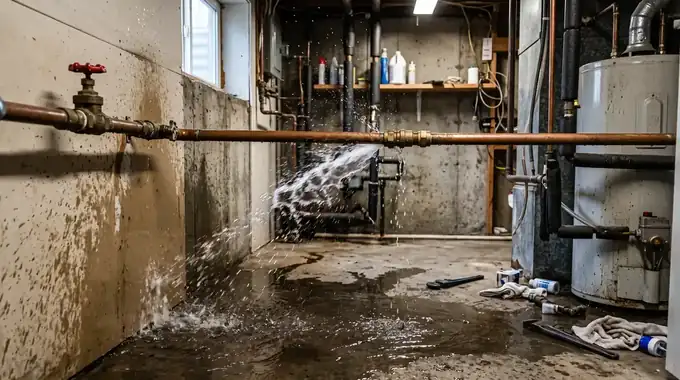
A burst pipe doesn't give you time to read a long guide. Water under household supply pressure — typically between 40 and 80 psi — discharges at a rate that can fill a room quickly and penetrate subfloors, wall cavities, and insulation in minutes. The actions you take in the first five to ten minutes determine how much secondary damage occurs beyond the pipe failure itself.
This article is written as a direct action guide. Read it now — before anything goes wrong — so the steps are familiar when you need them under pressure. Then bookmark the page, or print it and tape it inside your utility room door next to your main shutoff valve.
Immediate Actions: Step-by-Step
Step 1 — Locate and Close Your Main Water Shutoff Valve
Your first and most critical action is stopping the flow of water into the home. Every second the main is open, more water is entering the building. The main water shutoff valve controls the entire supply system from the service line forward — closing it stops water to every fixture and appliance in the home simultaneously.
Where to find your main shutoff valve: The location varies by home construction and era, but common locations include:
- Inside the garage: Often mounted on the wall near where the service line enters from the front yard, typically close to floor level.
- In the utility room or mechanical room: Near the water heater, on the wall where the supply line enters from the exterior.
- In the crawlspace access: Some homes route the service line directly into a crawlspace before branching to the main water heater. The shutoff may be just inside the crawlspace access hatch.
- Under a kitchen sink: Less common for a main shutoff, but some homes have the main supply valve accessible from the cabinet beneath the kitchen sink near the service line entry point.
- Near the curb meter box: The water meter at the curb has a shutoff on the homeowner's side of the meter, though this typically requires a meter key tool to operate. This is a backup option if the interior shutoff is inaccessible.
Once you've found the valve, close it fully. A ball valve closes with a quarter turn (perpendicular to the pipe = closed). A gate valve requires multiple full turns clockwise until it stops.
Step 2 — Turn Off Your Water Heater
After closing the main supply, protect your water heater. A tank-style water heater that continues heating with its supply cut off can sustain damage or, in the case of electric units, burn out its heating element if the tank runs dry from the supply side.
Electric water heater: Go to your home's electrical panel and switch off the breaker labeled for the water heater (typically a 240V double-pole breaker). This stops the heating element entirely. Do not operate the heater again until the supply is restored and the tank has time to fill.
Gas water heater: Turn the temperature dial or control knob to the Pilot position. This maintains the pilot light without activating the burner, protecting the unit until supply is restored. Do not set the gas valve to the Off position unless instructed by a professional — relighting pilots in some older units requires specific procedures.
Step 3 — Open a Cold-Water Tap at the Lowest Point
With the main closed, residual pressurized water remains in the supply pipes throughout the home. Opening a cold-water faucet at the lowest level — a basement laundry sink, a ground-floor bathroom faucet, or a utility sink — allows that pressure to release and helps drain residual water from the supply lines toward the lowest point rather than continuing to seep through the burst area.
Do not open the hot-water side at this stage if you have already switched off the water heater. Draining the hot side without an incoming cold supply can introduce air into the water heater tank in an uncontrolled way.
Step 4 — Mop or Absorb Standing Water Immediately
Water standing on hardwood, laminate, or engineered flooring begins absorbing into the material within minutes. Once moisture penetrates the subfloor, you're looking at subfloor replacement in addition to surface flooring. Moving quickly to absorb standing water reduces the depth of damage dramatically.
What to use: Old towels, bath towels, mops, and — most effectively — a wet-dry shop vacuum (also called a shop vac or wet vac). A shop vac can remove large volumes of standing water rapidly and is one of the most useful tools to own for any household water emergency.
What not to use: Do not use a standard household vacuum cleaner on standing water. Household vacuums are not designed for liquid and will be damaged or destroyed. If a household vacuum picks up water and has any electrical exposure, it also poses an electrocution risk.
Direct water away from wall edges and toward a central collection point for removal. Water that runs beneath baseboards reaches wall cavities, insulation, and the structural framing — damage that isn't visible from the room surface and that creates mold conditions over the following days.
Step 5 — Remove Valuables and Furniture From the Affected Area
Water-logged upholstered furniture is very difficult to restore. Electronics, documents, photographs, and other valuables that absorb water are often permanently damaged. Move these items out of the affected zone as soon as the immediate standing water situation is managed and it is safe to move through the area.
Lift furniture off wet carpet using furniture risers, plastic bags, or aluminum foil under the legs to prevent transfer of staining and rust from furniture hardware to carpet fibers. Wet padding beneath carpet traps moisture and should be removed and discarded if it has been saturated.
Step 6 — Call for Emergency Pipe Repair
Once the immediate water flow is stopped and the most urgent safety concerns are addressed, contact an emergency plumbing service for repair. A burst pipe requires professional assessment: the failed section of pipe must be cut out and replaced with correctly rated materials, all connections must be pressure-tested before the main is reopened, and the full extent of water intrusion should be evaluated for potential remediation needs.
Medford Leak Detectives provides Emergency Dispatch for burst pipe assessment and repair across Medford and Jackson County. Learn about our emergency burst pipe repair service →
| Emergency Priority Step | Exact Action to Take | Why It Prevents Secondary Damage |
|---|---|---|
| 1. Stop Incoming Water (Minute 1) | Turn house main shut-off ball valve 90° (or turn street curb-stop tang 90° clockwise) | Halts 8–18 GPM pressurized flow from expanding across ceilings and floors |
| 2. Protect Water Heater (Minute 2) | Flip 240V electric water heater breaker OFF (or turn gas control dial to PILOT) | Prevents upper electric heating element from dry-firing and burning out if tank siphons |
| 3. Bleed Residual Pressure (Minute 3) | Open the lowest cold faucet and an outdoor hose bib | Drains standing water out of vertical wall risers safely into a sink instead of your ceiling |
| 4. Isolate Wet Electrical Zones (Minute 4) | Switch off circuit breakers for rooms with wet ceiling lights, fans, or outlets | Eliminates shock and short-circuit fire hazards inside wet framing bays |
After the Water Is Off: Drying, Documentation, and Repair
Once the main valve is closed, the next few hours determine how much secondary damage you face. Moving quickly on drying and documentation protects both your home and any insurance claim.
Dry the Area Within 24 to 48 Hours
Mold can begin growing quickly in damp materials. Run fans, use dehumidifiers if you have them, and remove soaked rugs and low-lying items. Wet drywall and insulation often need professional drying or removal.
Document Everything for Your Insurance Claim
Take photos and video of the burst pipe, standing water, and every damaged surface before cleanup. Keep receipts for emergency repairs and drying equipment. Contact your insurance company promptly to understand your coverage.
Emergency Burst Pipe Repair in Medford, OR
Our emergency burst pipe repair service is available around the clock across Medford and Jackson County. If you are not sure where the water is coming from, we can also perform leak detection to confirm the source. Call (541) 906-0245 any time.
Pipes Most Likely to Burst in Medford Homes
Understanding your home's pipe material helps you anticipate where vulnerabilities may exist and what failure patterns to watch for before a full burst occurs.
Copper Pipe Pinhole Failures
Copper supply pipe — Type M and Type L — is the most common material in Medford homes built from the 1950s through the early 2000s. Copper is durable, but it is susceptible to pitting corrosion when water chemistry, electrical grounding conditions, or turbulent flow velocity are unfavorable. Pitting corrosion creates pinhole leaks that can begin as a slow seep and progress to a full failure under continued water pressure. Pinholes often appear in groups along a pipe run rather than as isolated failures.
CPVC Stress Fractures in Temperature Extremes
CPVC (chlorinated polyvinyl chloride) rigid plastic pipe was used extensively in residential construction from the 1970s through the 1990s. CPVC is susceptible to embrittlement from chemical exposure — certain pipe dopes, solvent cleaning agents, and even some fire retardant spray foams can degrade the material — and to brittle fracture under physical impact or thermal stress. CPVC pipes that have become brittle can shatter rather than crack, producing a sudden and significant failure rather than a gradual leak.
PEX Mechanical Failure at Crimp Fittings
PEX (cross-linked polyethylene) flexible pipe is the dominant material in residential construction today and is also widely used in re-piping work on older homes. PEX pipe itself is highly flexible and resistant to freeze-burst compared to rigid materials — it can expand significantly before failing. However, the mechanical connections — crimp rings, cinch clamps, or expansion fittings — are the more vulnerable components, particularly if the ring was improperly installed or has been subjected to repeated thermal cycling. Fitting failures at connections can produce sudden, significant leaks.
Older Galvanized Steel Pipe Failures
Galvanized steel supply pipe is found in Medford homes built before the 1960s, and occasionally in partial runs in homes that underwent partial re-piping. Galvanized pipe corrodes from the inside out over time, developing heavy internal rust scale that progressively reduces the pipe's effective diameter. Eventually, the pipe wall itself becomes compromised, and what began as reduced flow becomes a through-wall failure. Galvanized pipe failures often involve a section that is heavily scaled throughout — a single repair point may be followed by an adjacent failure.
Preventing Future Burst Pipe Emergencies
The most consequential thing you can do today — before anything goes wrong — is to locate your main shutoff valve and confirm it operates properly. Everything else follows from that single prepared action.
- Know where your shutoff valve is and confirm it turns: Walk to it now. Turn it partially. Note its condition. If it is stiff, corroded, or requires excessive force, have it serviced or replaced while it is still a routine task rather than an emergency one.
- Insulate exposed pipes in crawlspaces and exterior walls: Southern Oregon winters can produce freezing temperatures in Medford, particularly at higher elevations and during cold snaps. Pipes in unconditioned crawlspaces, garages, or against exterior walls that are not adequately insulated are at risk of freezing when outdoor temperatures drop well below freezing. Foam pipe insulation is inexpensive and straightforward to install.
- Address known drips and slow leaks promptly: A slow drip at a fitting, a pinhole seep at a copper joint, or a chronic wet spot at a supply line connection are warning signs that a pipe has reached a point of failure initiation. These do not typically improve on their own. A pipe that is dripping today is a more likely candidate for a sudden burst later — particularly if temperatures drop or if water pressure spikes.
- Check your water pressure: If your home does not have a functioning pressure reducing valve (PRV), or if your PRV has failed, supply pressure above recommended levels accelerates deterioration of all pipe materials and fittings. A simple pressure gauge attached to a hose bib gives you an immediate reading. Recommended residential supply pressure is typically in the 40–60 psi range — though your plumber can advise on what applies to your specific system.
- Monitor your water meter for unexplained loss: If your water bill increases without a clear explanation — no additional irrigation, no new appliances, no increase in household use — run the meter check described in related articles. A slow underground or in-wall leak that is consuming water invisibly may be a precursor to a more significant failure.
What NOT to Do
In the heat of a burst pipe emergency, a few common mistakes can make an already serious situation significantly worse.
- Do not use an electric appliance or tool in a wet area. This includes portable heaters, fans, vacuums, and hair dryers used for any purpose in a water-flooded room before the power is confirmed off and the water is removed. Water and live electricity are a lethal combination.
- Do not attempt to solder or repair a pipe while water pressure is active. You cannot solder a copper pipe joint that has any moisture in it — the steam prevents the solder from flowing into the joint properly. And attempting to grip, cut, or modify pressurized pipe without closing the main first will result in continued or worsened water release.
- Do not use a standard household vacuum on standing water. This was mentioned above but bears repeating: household vacuums are not rated for liquid pickup, will be immediately destroyed, and pose a shock hazard in a wet environment. Use a wet-dry shop vac only.
- Do not ignore a slow drip that preceded the burst — document it. If you noticed a drip or wet spot in the days or weeks before a pipe failed, note that information and share it with your plumber and your insurance adjuster. It may be relevant to the repair assessment and to any insurance claim you file.
- Do not assume the damage is limited to what you can see. Water moves through hidden cavities faster than it appears on surfaces. After any burst pipe event, a thorough assessment of moisture in walls, subfloors, and insulation — using moisture meters or thermal imaging — is a prudent next step even if the visible damage appears contained.
Written by Medford Leak Detectives
acoustic water leak detection and pipe repair specialists serving Medford, OR and the greater Jackson County area. We use acoustic, thermal imaging, and tracer gas methods to pinpoint leaks without demolition.
Dealing With an Active Burst Pipe in Medford Right Now?
Visit our emergency burst pipe repair page or call Medford Leak Detectives directly at (541) 906-0245 for 24/7 dispatch.
Call (541) 906-0245How to Handle an Emergency Leak in Your Home & Schedule Emergency Pipe Repair
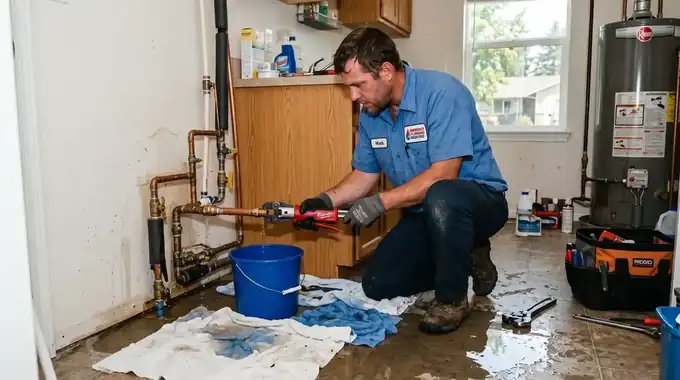
Knowing how to handle an emergency leak in your home during a sudden water leak emergency or burst pipe emergency prevents thousands of dollars in structural water damage. After closing your main shut-off valve and turning off power to affected circuits, call our 24 hour water leak repair Medford and burst pipe repair Medford dispatch line at (541) 906-0245 to schedule emergency pipe repair. Whether you need emergency water line repair Medford, emergency plumbing Medford, or acoustic instruments to detect pipe burst splits inside insulated walls, our technicians restore safe water service and implement long-term pipe damage prevention.
Frequently Asked Questions About Burst Pipe Emergencies in Medford, OR
Where is the main water shut-off valve located in most Medford homes?
In newer East Medford and South Medford homes built after 1990, the house main shut-off valve is typically located inside the garage on an exterior-facing wall or immediately adjacent to the water heater. In older pre-1975 Central and West Medford homes, the house shut-off is frequently inside the crawlspace near the front foundation wall, or you can shut the water off directly at the Medford Water Commission curb box near the street.
Should I turn off my water heater after shutting off the main water valve?
Yes. Always switch an electric water heater breaker off at the panel or turn a gas water heater control valve to the "Pilot" or "Off" position immediately after closing the main water supply. If the tank drains backward through a lower-level pipe break, exposed electric heating elements can burn out or superheat the tank.
Do I need a special tool to turn off the Medford Water Commission meter at the street?
Most residential meter boxes along the curb contain a customer-side ball valve or a meter stop valve with two rectangular ears. While a dedicated T-handle curb key makes turning it easy, you can also use an adjustable crescent wrench or channel-lock pliers to rotate the valve 90 degrees until the locking holes align perpendicular to the pipe.
Why do burst pipes happen in Medford when temperatures only drop into the low 20s?
Because Rogue Valley winters are generally mild, builders frequently routed domestic PEX, CPVC, and copper supply lines through unheated attics, uninsulated garage walls, and vented crawlspaces without freeze protection. When a sudden December or January cold snap drops overnight temperatures to 15°F–22°F, stagnant water in exterior walls and hose bibs freezes, expands, and splits the pipe wall.
What should I document for my homeowners insurance claim after a sudden pipe burst?
Take clear photos and video of the active leak or split pipe before it is discarded, photograph affected drywall, baseboards, and flooring, keep the damaged pipe section if replaced, and save the written diagnostic and repair invoice showing that the water escape resulted from a sudden accidental rupture.
How to handle an emergency leak in your home before the Medford plumber arrives?
First, shut off your home's main water valve (or the Medford Water Commission street curb stop if the indoor valve fails). Second, shut off power or gas to your water heater to prevent element burnout. Third, open the lowest indoor and outdoor faucets to drain residual pressure, and call (541) 906-0245 for 24 hour water leak repair Medford.