
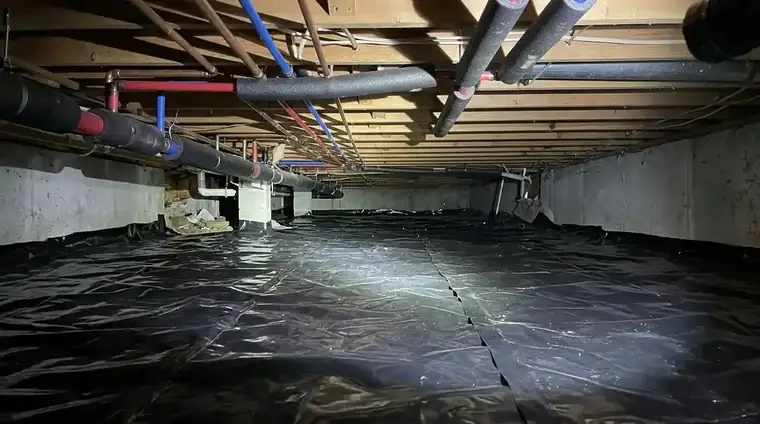
In Medford and Jackson County, the worst pipe-burst emergencies rarely happen during mild 30°F rain/snow showers. They happen during clear, calm winter radiation inversions—when dense freezing air settles into the Rogue Valley floor and overnight lows plunge to 12°F to 22°F for several consecutive days.
Understanding the physics of a pipe freeze explains why pipes burst where they do: as ice crystals form inside an uninsulated section of pipe, the ice expands by roughly 9% and forms a solid plug. That expanding ice plug pushes unfrozen liquid water forward toward closed indoor faucets—compressing the trapped water to over 2,000 PSI until a copper elbow, CPVC tee, or brass valve body splits open!
In This Guide
- The 5 Pipes That Freeze First in Medford Homes
- Pre-Winter Checklist (Late October / Early November in Medford)
- What to Do When the Forecast Calls for Under 22°F in Medford
- How to Thaw a Frozen Pipe Safely (And Check for Hidden Splits)
- Permanent Winterization Upgrades Our Plumbers Install
- Frequently Asked Questions
1. The 5 Pipes That Freeze First in Medford Homes
| Vulnerable Plumbing Zone | Why It Freezes in Medford | How to Protect It Before Winter |
|---|---|---|
| 1. Exterior Hose Bibs (With Garden Hoses Attached) | Leaving a garden hose screwed onto a spigot traps water inside the brass barrel—even on a 'frost-free' sillcock—splitting the copper tube inside the wall | Disconnect all garden hoses by November 1st and place insulated foam covers over every exterior hose bib |
| 2. Crawlspace Pipes Next to Open Foundation Vents | Older West Medford, Liberty Park, and South Medford homes often have copper or CPVC pipes running 6 inches behind open metal mesh foundation vents | Install snug styrofoam foundation vent plugs from November through March and sleeve exposed pipes in 1/2-inch closed-cell foam insulation |
| 3. Irrigation Backflow Preventers (DCVA / RPZ Boxes) | Shallow brass backflow assemblies in front lawns or above-ground cages freeze solid if not shut off and drained after summer watering ends | Close the upstream isolation valve, open the small brass test cocks at a 45° angle to bleed trapped water, and insulate the valve box |
| 4. Unheated Garage Walls & Water Heater Risers | Many 1980s–2010s North and East Medford homes route the main water shut-off, PRV, and water heater pipes through an unheated north/east garage wall | Keep garage doors closed overnight, wrap exposed copper risers/PRVs with foam pipe insulation, and seal cold air drafts at the foundation sill |
| 5. Attic PEX / Copper Reroutes & Recirculation Lines | Pipes routed high over ceiling joists *above* the blanket of blown-in attic insulation are exposed to 15°F vented attic air | Ensure attic water lines rest against the warm drywall ceiling *beneath* attic insulation and are wrapped in closed-cell foam sleeves |
2. Pre-Winter Checklist (Late October / Early November in Medford)
- Disconnect & Drain All Garden Hoses & Hose Splitters: This single 5-minute task prevents nearly 40% of residential winter wall leaks. A frost-free hose bib only works if water can drain out of the 8-to-12-inch stem when you turn the handle off; a connected hose or Y-splitter holds water inside the wall where it freezes and splits the copper barrel.
- Shut Off & Bleed Your Landscape Irrigation System: Once Medford Irrigation District ditches close or you turn off your MWC sprinkler controller for the season, shut off the main irrigation isolation valve and bleed the brass Double Check Valve Assembly (DCVA) test cocks (leave test cocks at a 45-degree half-open angle so freezing droplets have room to expand without cracking the brass ball valves).
- Plug Exterior Crawlspace Foundation Vents: Walk the perimeter of your home and install foam vent blocks in foundation vents (taking care never to block combustion-air vents for gas furnaces or water heaters!). Verify that the crawlspace access hatch fits tightly so freezing wind cannot blow under the subfloor.
- Locate & Test Your Main Water Shut-Off Valve Now: Do not wait until a thawed pipe is spraying 15 gallons a minute out of your ceiling on a Sunday morning to look for your main shut-off valve. Locate your interior main valve (and street curb meter box) today and make sure the handle turns smoothly.
3. What to Do When the Forecast Calls for Under 22°F in Medford
- Open Vanity & Kitchen Sink Cabinet Doors on Exterior Walls: If your kitchen sink or bathroom vanity sits against an outside wall, leave the cabinet doors propped open overnight so warm room air circulates around the angle stops and supply risers.
- Let Vulnerable Faucets Drip at a Slow Pencil-Lead Trickle: Moving water resists freezing, and more importantly, an open faucet downstream prevents a forming ice plug from building 2,000 PSI of trapped hydraulic pressure inside the pipe!
- Never Set the Thermostat Below 55°F When Traveling: Turning the heat completely off during a winter vacation in Southern Oregon allows interior partition walls and crawlspaces to drop below freezing within 36 hours. If leaving a home vacant all winter, shut off the main water valve, turn off the water heater breaker/gas, and drain the domestic lines.
4. How to Thaw a Frozen Pipe Safely (And Check for Hidden Splits)
- Know the exact location of your main water shut-off valve so you can close it in 5 seconds if water begins spraying as the ice melts.
- Open the faucet that the frozen pipe feeds so melting water and steam can escape safely.
- Use a hair dryer, warm wet towels, or UL-listed heating pad—never use a propane blowtorch, kerosene heater, or open flame!
- Once full flow returns at the faucet, turn all faucets off and check your Medford Water Commission curb meter for 3 minutes. If the low-flow dial is spinning, the frozen pipe split inside a hidden crawlspace or wall cavity and needs immediate repair!
5. Permanent Winterization Upgrades Our Plumbers Install
If your Medford property has a history of freezing pipes during winter cold snaps, Medford Leak Detectives installs code-compliant plumbing upgrades that solve the problem permanently:
- Frost-Free Anti-Siphon Sillcock Replacements: Replacing old brass outdoor spigots with 10-inch or 12-inch frost-free hydrants whose internal valve seat sits deep inside the heated living space.
- Dedicated Interior Hose-Bib & Irrigation Shut-Off Ball Valves with Bleed Ports: Allowing you to shut off and drain exterior lines from inside the garage or utility room in 30 seconds.
- Closed-Cell Pipe Insulation & Self-Regulating Heat Cable: Insulating exposed crawlspace and garage manifolds, or replacing brittle freeze-prone CPVC/copper crawlspace trunks with flexible, freeze-resilient PEX-a tubing.
Medford Winter Pipe Freeze & Thaw: Frequently Asked Questions
Why did my frost-free outdoor faucet burst inside the wall when it says 'Anti-Siphon Frost-Free' on the handle?
A frost-free hose bib has a long copper tube that reaches 8 to 12 inches inside your warm floor joists or wall, and it relies on gravity to drain the outer barrel empty every time you shut it off. If you leave a garden hose or brass Y-splitter attached over the winter, water stays trapped inside that outer copper tube, freezes solid, splits the copper barrel inside your wall, and sprays into your house the next time you turn the spigot on in spring!
Should I close my crawlspace vents in Medford during the winter and open them in the summer?
For standard vented dirt/vapor-barrier crawlspaces in the Rogue Valley (provided there are no gas appliances drawing combustion air from the crawlspace), plugging exterior foundation vents from November through March prevents freezing 15°F wind from blowing across your water pipes, and removing the plugs in spring restores warm-season ventilation.
Does PEX pipe burst as easily as copper or CPVC when it freezes?
Cross-linked polyethylene (especially PEX-a) is far more elastic than rigid copper or brittle CPVC and can expand considerably around an ice plug before rupturing. However, brass or poly fittings, manifolds, and valves connected to PEX can still crack when frozen solid, so PEX in unheated crawlspaces and attics should always be insulated.
What if only my hot water is frozen on a cold morning while cold water still runs?
That happens frequently in Medford for two reasons: (1) hot water lines are sometimes routed slightly closer to exterior walls or high in an attic reroute, and (2) hot water that has cooled overnight contains fewer dissolved gas bubbles and can supercool and freeze quickly in an uninsulated drafty spot.
How do you find where a frozen pipe split if my crawlspace is too tight to crawl into?
We use zone isolation, hydrostatic pressure testing, acoustic contact probes, and FLIR thermal imaging from above the floor and at the crawlspace access to pinpoint which exact branch ruptured before accessing and repairing the line.
Have a Frozen or Split Pipe in Medford Right Now?
Shut off your main water valve before the ice thaws and call Medford Leak Detectives at (541) 906-0245 for emergency burst pipe repair and multi-point leak testing.
Call (541) 906-0245