
In a standard 16×32 foot residential swimming pool (~512 square feet of surface area), every 1 inch of water depth equals roughly 320 gallons of water. During a hot Rogue Valley summer week when daytime highs hit 95°F–103°F, dry afternoon breezes blow across the water, and nighttime lows drop into the 50s, normal evaporation typically removes ¼ inch to ⅜ inch per day (roughly 80 to 120 gallons per day, or 1.75 to 2.5 inches per week).
Because evaporation varies dramatically from week to week with humidity, wind, wildfire smoke cover, and water heater settings, guessing based on a ruler measurement alone can be misleading. The 24-hour bucket comparison test eliminates weather variables completely.
In This Guide
1. Step-by-Step: How to Run the 24-Hour Bucket Comparison Test
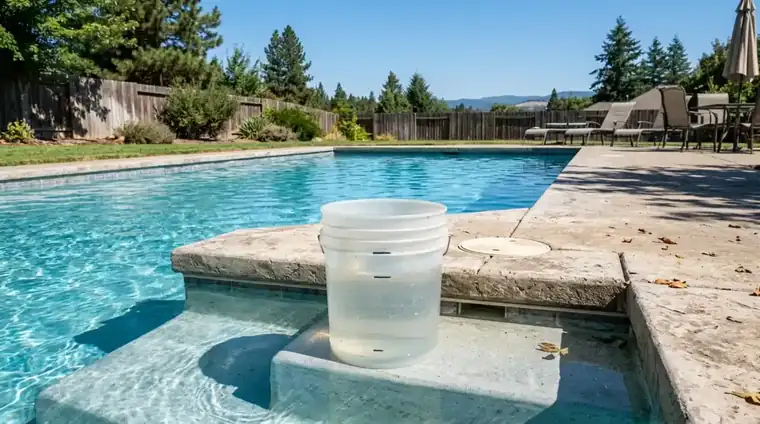
Why does a simple 5-gallon bucket resting on your pool step work better than weather formulas? Because when the bucket sits partially submerged in the pool, the water inside the bucket stays at the exact same temperature and experiences the exact same sunlight, wind, and relative humidity as the pool itself—except the bucket has no plumbing pipes or plaster cracks!
- Disable Any Automatic Pool Leveler (Auto-Fill): If your pool has an automatic toilet-style float valve in a deck canister, shut off its water supply valve first. Otherwise, the auto-fill will continuously replace lost pool water and hide the leak (while running up your Medford Water Commission bill!).
- Submerge a 5-Gallon Bucket on the First or Second Pool Step: Place a clean 5-gallon bucket on the step so at least 6 to 8 inches of the bucket is underwater. Place one smooth brick or heavy cobble on the bottom of the bucket so it cannot float away, and fill the bucket with pool water until the inside level matches the outside pool water level.
- Mark Both Water Levels Accurately: Stick a strip of waterproof vinyl electrical tape (or draw a crisp line with a wax grease pencil) at the water line on the inside of the bucket and at the pool water line on the outside of the bucket.
- Wait 24 Hours (No Swimming, No Backwashing, No Rain): Keep swimmers and pets out of the pool so splash-out does not skew the outside level. After exactly 24 hours, measure the drop from the top edge of both tape marks. If the outside pool water dropped ½ inch while the water inside the bucket only dropped ¼ inch, your pool is losing an extra ¼ inch per day (~80 gallons/day) to a leak!
2. The Two-Phase Bucket Test: Pump ON vs. Pump OFF (Plumbing vs. Shell)
If your bucket test confirms a leak, running the bucket test twice—once for 24 hours with the circulation pump running continuously, and once for 24 hours with the circulation pump switched completely off—narrows down which part of the pool is leaking:
| Test Result Comparison | What It Points To | Common Leak Problems & Locations |
|---|---|---|
| Pool loses much MORE water during the 24 hours when the pump is ON | Pressurized Return-Side Plumbing Leak (or multiport backwash valve bypassing to waste) | Cracked underground PVC return pipe beneath the pool deck, leaking heater header, or torn spider gasket in the backwash valve |
| Pool loses water at the SAME rate whether the pump is ON or OFF | Static Structural Shell / Penetration Leak | Separation between the plastic skimmer throat and concrete bond beam, leaking underwater light conduit, or plaster/tile-line crack |
| Air bubbles blow out of return jets when pump is ON; water drops when pump is OFF | Suction-Side Plumbing Leak (skimmer or main drain pipe) | Cracked 90° PVC elbow directly underneath the skimmer box or underground suction line between the skimmer and pump |
| When left un-topped, water stops dropping right at the bottom of the skimmer mouth or light | Elevation-Specific Penetration Leak | Proves the leak sits at that exact horizontal water level (usually the skimmer throat seam or underwater light niche) |
3. 5 Safe Visual Checks Around the Equipment Pad & Skimmer
Before assuming a pipe is broken beneath four inches of concrete decking, check these five above-ground spots:
- Check the Backwash / Waste Discharge Pipe While the Pump Runs: On sand and DE filters with a multiport handle (Filter / Backwash / Rinse / Waste), a worn rubber "spider gasket" inside the valve often allows water to trickle continuously out the waste line into the yard or sewer cleanout while set to "Filter."
- Inspect Beneath the Pump Shaft Seal & Union Collars: Look under the belly of the main circulation pump motor where the wet end meets the electric motor; a failed ceramic mechanical shaft seal drips continuously while running and rots out the pump bearings.
- Look Inside the Skimmer Throat (Between the Tile & Plastic): Remove the skimmer lid and look closely at the vertical mortar joint where the white or gray plastic skimmer mouth meets the pool tile and concrete wall. In Medford's hot-to-freezing seasonal swings, the plastic and concrete expand at different rates, opening a 1/16-inch gap that drinks water all day.
- Watch the Pump Strainer Basket Lid for Churning Air Bubbles: If the clear pump basket lid is full of swirling air bubbles when the water level is halfway up the skimmer tile, air is being sucked in through a loose pump lid O-ring, drain plug, or a cracked underground suction pipe.
- Walk the Pool Deck Perimeter & Downhill Lawn Slope: Look for a single section of concrete pool decking that has settled 1/2 inch lower than adjacent slabs, or an unusually lush green strip of grass downhill from the pool.
4. How Underwater Hydrophones, Dye & Pressure Testing Pinpoint the Leak
When you schedule a pool and irrigation leak inspection with Medford Leak Detectives, we systematically test both the vessel and the buried plumbing:
- Underwater Acoustic Hydrophone Listening: Water escaping through a hairline shell crack, main drain hydrostatic relief valve, or light conduit generates an acoustic vortex underwater that our submerged hydrophone detects from several feet away.
- High-Contrast Syringe Dye Verification: With the circulation pump off and the water completely calm, releasing a wisp of weighted fluorescent dye 1/2 inch from a suspected crack or skimmer seam lets us watch the leak physically pull the dye ribbon straight into the opening.
- Isolated Line Pressure Decay & Deck Acoustic/Gas Pinpointing: We plug individual skimmer, return, and cleaner lines and pressurize them with a calibrated air/water test rig. If an underground PVC line fails to hold pressure, we listen through the concrete deck with an acoustic deck plate (and use forming gas when needed) to mark the exact square of deck above the broken pipe.
Pool Evaporation vs. Leak Testing: Frequently Asked Questions
Why shouldn't I let my pool drain all the way down to see where the water level stops?
Never let a swimming pool drop more than a few inches below the skimmer mouth without professional guidance! Dropping the water level too low can allow a vinyl liner to shrink and pull out of its track, ruin fiberglass/plaster finishes in hot Rogue Valley sun, or allow groundwater pressure to float or crack the pool shell.
Can wildfire smoke or wind in August change how much my pool evaporates?
Yes. Low humidity coupled with warm afternoon winds across the Rogue Valley significantly increases evaporation (especially if your pool water is heated above 80°F while nighttime air drops to 55°F). That is why the 24-hour bucket test is so reliable—wind, heat, and humidity affect the bucket and the pool equally.
How do underwater pool lights leak when the glass lens isn't broken?
Underwater pool lights rarely leak through the glass lens itself. Instead, the light fixture sits inside a flooded metal or plastic 'niche' recessed in the pool wall, and a thick electrical power cord exits the back of that niche through a conduit pipe up to the deck junction box. When the rubber cord grommet or epoxy seal at the back of the niche degrades, pool water drains right out through the electrical conduit pipe!
Can a skimmer throat crack be repaired without draining the pool or tearing up the deck?
Yes! If the leak is limited to the separation joint where the plastic skimmer throat meets the concrete bond beam (and not the underground PVC pipe beneath the skimmer), it can usually be sealed cleanly right at the waterline using specialized two-part underwater structural pool putty.
How do I know if a soggy lawn near my pool is a pool leak or a broken lawn sprinkler pipe?
Run the 24-hour pool bucket test while also checking your Medford Water Commission street water meter with all indoor taps and sprinkler timers off. If the street meter spins continuously while your pool auto-fill is shut off, your pressurized lawn sprinkler mainline or domestic yard line is leaking.
Can pool water testing Medford show if my swimming pool has a hidden leak?
Yes. Because evaporation only removes pure water vapor while leaving salt and cyanuric acid (stabilizer) behind, a steady drop in stabilizer or salt readings during routine Medford pool water testing indicates that treated water is leaking out and being diluted by fresh autofill tap water.
Did Your Medford Pool Fail the 24-Hour Bucket Test?
We use underwater acoustic hydrophones, precision dye testing, and plugged-line pressure testing to pinpoint pool and spa leaks without unnecessary deck demolition. Call Medford Leak Detectives at (541) 906-0245 or view our pool and irrigation leak detection service.
Call (541) 906-0245Chemical Pool Water Testing Medford: Stabilizer & Salt Dilution Checks
Alongside the 24-hour bucket test, professional pool water testing Medford and Medford pool water testing provide a reliable secondary indicator of a hidden leak, especially in pools equipped with automatic water levelers (autofills). When water evaporates naturally in the Rogue Valley sun, dissolved minerals, salt, and cyanuric acid (stabilizer) remain behind in the pool. When a structural shell crack or underground return pipe leaks, chemically treated water escapes and the autofill replaces it with fresh Medford Water Commission tap water—causing rapid drops in stabilizer, salt, and TDS levels during routine pool water testing Medford checks before we perform hydrophone pool leak detection Medford and pool leak repair Medford.