
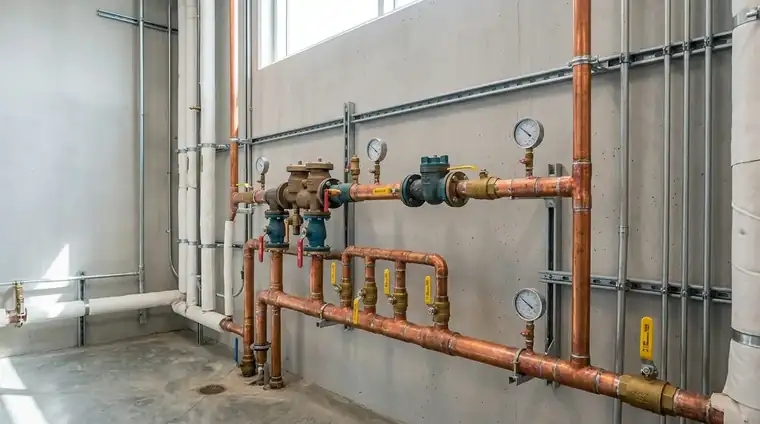
Unlike a single-family home where one family notices a warm tile or a running toilet within days, commercial buildings mask water leaks aggressively. Thick 6-to-8-inch reinforced concrete slabs, continuous background HVAC and equipment noise, multi-tenant master water meters, and 24/7 commercial water equipment allow a sub-slab or underground pipe failure to waste 50,000 to 200,000+ gallons over a billing cycle before accounting flags the utility invoice.
In This Guide
- 7 Early Warning Signs of a Concealed Commercial Leak
- Leak Hotspots by Medford Commercial Building Type
- The 10-Minute Facility Manager Meter & Equipment Audit
- Why Pumped Hot-Water Recirculation Loops Fail in Commercial Buildings
- How Commercial Leak Detection & Repair Avoids Business Closures
- Frequently Asked Questions
1. 7 Early Warning Signs of a Concealed Commercial Leak
- Step-Change Increases in Medford Water Commission & Sewer Charges: Compare current usage (in thousands of gallons or CCF) against the exact same month from the prior year rather than just the previous month, so seasonal summer irrigation doesn't disguise a domestic main leak.
- Warm Quarry Tile or Loose Vinyl Composition Tile (VCT) Adhesive: When a 140°F commercial hot-water line leaks beneath a slab, rising moisture and heat emulsify floor tile mastic—causing VCT squares in breakrooms or hallways to pop loose or ooze dark adhesive at the seams.
- Commercial Water Heater or Boiler Firing Continuously During Off-Hours: If your high-BTU commercial gas water heater in a restaurant or hotel cycles on every 15 minutes at 11:00 PM when all dishwashers and prep sinks are shut off, hot water is escaping beneath the slab or inside a wall.
- Efflorescence & Damp Concrete Along Exterior Tilt-Up or Stem Walls: White crystalline mineral deposits or dark damp bands along the bottom 12 inches of concrete block or tilt-up warehouse walls indicate sub-slab water wicking upward.
- Asphalt Depression, Alligator Cracking, or Constant Curb-Gutter Trickle in the Parking Lot: Buried PVC or ductile-iron water mains leaking under a parking lot wash out compacted base rock, creating localized pavement dips and sending clear water into storm drain catch basins during dry weather.
- Weeping RPZ Backflow Preventer Relief Ports: Commercial properties in Medford use Reduced Pressure Zone (RPZ) backflow assemblies inside heated enclosures or exterior cages. Continuous spitting from the bottom relief port signals either debris in the check valve or downstream thermal expansion pressure spikes.
- Persistent Sewer or Grease Odors Near Floor Drains: While dry P-traps are common in unused restrooms (usually cured by pouring water and mineral oil into the drain), persistent odors in active commercial kitchens often point to rotted cast-iron grease interceptor lines beneath the slab.
2. Leak Hotspots by Medford Commercial Building Type
| Medford Facility Type | Primary Hidden Leak Culprit | Silent Equipment Culprits to Check First |
|---|---|---|
| Restaurants, Breweries & Food Service | Sub-slab 140°F copper manifold under dishpit/three-compartment sinks; rotted cast-iron grease lines | Dipper wells (running 0.5–1.0 GPM all day), water-cooled ice machine solenoids, pre-rinse spray valves, and walk-in condensate drains |
| Medical, Dental & Veterinary Clinics (Barnett Rd / East Medford) | Eroded 90° copper elbows on continuous hot-water recirculation loops inside walls/ceilings | Reverse-osmosis (RO) water purification reject lines, vacuum pumps, autoclave condensers, and automatic sensor flushometers |
| Multi-Tenant Retail Strip Centers (Hwy 62 / Hwy 99 / Downtown) | Buried domestic main or irrigation lateral under asphalt parking lot; shared-meter suite branch leaks | Stuck diaphragm in a tenant's commercial 1.6/3.5 GPF Sloan/Zurn flushometer valve or leaking rooftop evaporative cooler float |
| Hotels, Assisted Living & Multi-Family Complexes | High-velocity copper recirculation return loops, stacked bathroom risers, and pool/spa equipment pads | Commercial laundry fill valves, boiler auto-fill makeup regulators, and stuck toilet flappers across 20+ units |
3. The 10-Minute Facility Manager Meter & Equipment Audit
Before scheduling an on-site acoustic and thermal scan, a facility manager or maintenance lead can gather three critical data points during a quiet window (such as 30 minutes before opening or after closing):
- Check the Master MWC Meter & Record Flow Rate (GPM): Open the street meter vault and observe the digital flow rate or sweep hand with all restrooms and sinks unused. Note whether the flow is a slow seep (0.1–0.3 GPM) or a major break (2.0+ GPM).
- Isolate the Landscape Irrigation RPZ / DCVA Backflow Assembly: Close the quarter-turn ball valve on your exterior landscape irrigation backflow preventer. If the master water meter drops to 0.00 GPM, the leak is in your exterior PVC irrigation mainline or zone valves—not inside the building!
- Shut Off Water-Using Commercial Appliances Briefly: Close the supply valves to water-cooled ice machines, dipper wells, RO filter skids, and trap primers. If the meter still registers continuous flow after all process equipment and irrigation are shut off, you have a true structural pipe leak.
4. Why Pumped Hot-Water Recirculation Loops Fail in Commercial Buildings
In commercial buildings with long pipe runs, code requires hot water to reach public handwashing lavatories quickly, which is achieved with a pumped recirculation loop. When a bronze or stainless circulator pump runs 24/7 at excessive velocity (or without a properly adjusted balancing valve), microscopic vapor bubbles form and collapse at the inside turn of 90-degree copper elbows—a process called cavitation erosion-corrosion.
Within 7 to 15 years, the inside bend of a copper elbow wears razor-thin and bursts. Because the recirculation loop is under continuous pump and street pressure, it sprays hot water into ceiling plenums, partition walls, or beneath concrete slabs 24 hours a day.
5. How Commercial Leak Detection & Repair Avoids Business Closures
- Early-Morning Pre-Open Acoustic & Thermal Scans: Testing between 5:30 AM and 8:30 AM before hood fans, dishwashers, and customer traffic start up.
- Overhead Plenum Reroutes vs. Floor Demolition: Routing replacement insulated commercial copper or PEX-a overhead through drop-ceiling plenums so restaurant quarry tile and retail floors never have to be jackhammered.
- Flameless Hydraulic ProPress Copper Joining: Eliminating open soldering torches, smoke, and fire-watch delays inside commercial ceilings.
Commercial Water Leak Troubleshooting: Frequently Asked Questions
How can we tell which retail tenant is causing a high water bill when 6 suites share one Medford Water Commission meter?
Each suite in a strip center typically has an individual isolation ball or gate valve located either in the rear utility corridor, above the restroom drop ceiling, or in an exterior manifold box. By watching the street meter while closing one suite valve at a time for 60 seconds, we identify the exact suite drawing water.
Can a commercial toilet flushometer (lever valve without a tank) leak silently?
Yes. While flushometer toilets do not have a tank flapper, a worn internal rubber diaphragm or fouled bypass orifice inside a Sloan or Zurn flushometer can stick partially open—allowing water to stream continuously into the bowl at 1 to 3 gallons per minute without making a loud noise.
Why are vinyl floor tiles lifting and oozing black glue in our office hallway?
When a sub-slab pipe leaks—especially a hot water or recirculation line—warm moisture vapor migrates up through the porous concrete slab and reacts with the alkaline cement and water-soluble tile adhesive, turning the glue slick and loosening the tiles long before standing water puddles on top.
How do you locate a water main break under an asphalt parking lot without digging trenches?
We connect an electromagnetic signal transmitter to trace the exact path and depth of the buried main across the parking lot, sweep the pavement with digital frequency-filtered ground microphones, and introduce non-toxic 5% hydrogen / 95% nitrogen tracer gas that rises through the asphalt at the exact fracture point.
Do you provide written diagnostic reports and invoices for corporate facility managers and HOA boards?
Yes. Every commercial service call includes a written diagnostic report detailing meter flow readings, isolation test results, thermal/moisture photos, and itemized repair recommendations or completed repair invoices.
Managing a Commercial Property or Restaurant in Medford?
We offer daytime and early-morning pre-open acoustic and thermal leak diagnostics across Jackson County. Call Medford Leak Detectives at (541) 906-0245 or review our commercial leak detection service.
Call (541) 906-0245